
What is the 10-point-must system?
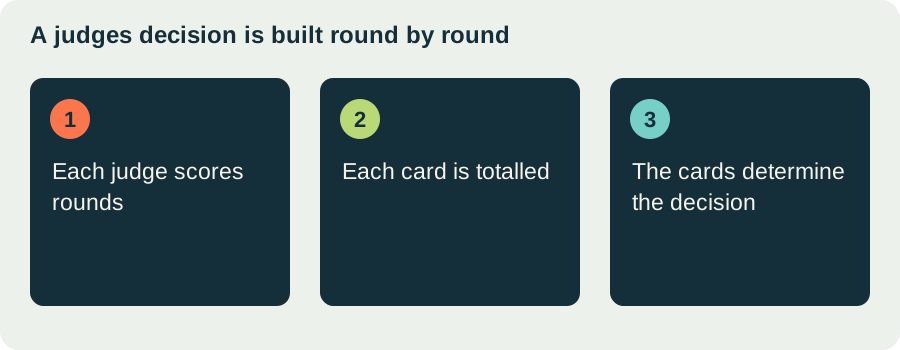
In the professional boxing system discussed here, judges assess each round separately. The round winner normally receives 10 points and the opponent receives nine or fewer, before any referee-ordered deductions are applied. A close or ordinary winning round is usually 10-9; a more decisive round can create a wider score. An even round is possible but should be rare. The ABC professional boxing judge manual explains these distinctions.
“Must” does not mean a boxer is guaranteed to keep 10 after a foul deduction. A 10-9 winning score can become 9-9 if the referee orders a one-point penalty against the round winner. Keep the assessment of the boxing and the penalty as two separate steps.
What do boxing judges look for?
The ABC framework identifies clean and effective punching, effective aggression, ring control and defence. It does not award a round merely because one boxer walked forward or the crowd cheered louder. Judges assess what the actions achieved. The ABC regulatory guidelines also distinguish a judge’s scoring responsibility from the referee’s authority to call deductions.
For a viewer, a useful question is whether a boxer lands cleanly while reducing the opponent’s effective answers. A punch that looks dramatic from one camera angle may be blocked or miss. Equally, a solid body shot deserves attention even if it produces less crowd reaction than a head punch. Rewatching the full round is more useful than replaying only its biggest moment.
A 10-9 round is not always a close round
Two rounds can both be 10-9 while feeling quite different. One can be almost even, with a small edge in effective work. Another can have a clear winner without reaching the threshold for a wider score. The number describes the scoring category, not a precise measurement of how much better one boxer looked.
This explains an apparently wide total in a competitive fight. In a hypothetical 12-round bout with no deductions or wider rounds, a boxer who narrowly wins every round would finish 120-108. The total looks emphatic because twelve separate one-point margins have accumulated. It does not require every round to have been one-sided.
Knockdowns and 10-8 rounds
A knockdown commonly produces a 10-8 round, but the rest of the round still matters. The ABC manual explicitly discusses exceptional situations in which a boxer scores a knockdown while being decisively outboxed elsewhere in the round. It also allows an extremely dominant 10-8 without a knockdown. Treat “one knockdown always equals one fixed score” as an oversimplification.
For a straightforward fictional example, Boxer A wins most exchanges and scores a knockdown. A 10-8 card for A gives a two-point round margin. If a different boxer then wins the next round 10-9, that recovery reduces the running deficit by one; it does not erase the entire knockdown round. Always total both columns rather than counting rounds won alone.
A complete six-round scorecard
The following invented bout illustrates the calculation. These figures are not an official fight result or a prediction. In round three, A wins a knockdown round 10-8. In round five, B wins the boxing 10-9 but is then penalised one point, making that round 9-9.
| Round | Boxer A | Boxer B | Explanation |
|---|---|---|---|
| 1 | 10 | 9 | A wins the round. |
| 2 | 9 | 10 | B wins the round. |
| 3 | 10 | 8 | A wins a 10-8 knockdown round. |
| 4 | 9 | 10 | B wins the round. |
| 5 | 9 | 9 | B’s 10-9 becomes 9-9 after a one-point deduction against B. |
| 6 | 10 | 9 | A wins the round. |
| Total | 57 | 55 | This judge awards the bout to A. |
A’s column is 10 + 9 + 10 + 9 + 9 + 10 = 57. B’s is 9 + 10 + 8 + 10 + 9 + 9 = 55. Notice that the totals add to 112, not the 114 you might expect from six ordinary 10-9 rounds. The 10-8 round removes one extra point from the usual total, and the deduction removes another.
This gives you a useful arithmetic check, not proof that the judging was correct. A card can add up perfectly while containing disputed round assessments. Conversely, an addition error is different from disagreement about who won a close round.
How three cards become a decision
In a conventional three-judge professional contest, each judge’s final card first identifies a winner or a draw. Those outcomes are then combined. Do not add all the judges’ points into one giant score.
| Decision | Judge 1 | Judge 2 | Judge 3 |
|---|---|---|---|
| Unanimous decision for A | A | A | A |
| Split decision for A | A | A | B |
| Majority decision for A | A | A | Draw |
| Unanimous draw | Draw | Draw | Draw |
| Majority draw | Draw | Draw | A or B |
| Split draw | A | B | Draw |
Suppose A leads 58-56 on two cards, while B leads 60-54 on the third. The result is a split decision for A. B’s larger margin on one card does not outweigh the other two cards. The WBC’s discussion of split decisions explains why agreement on the winner and similarity of scoring margins are different questions.
When the fight stops before the final bell
A stoppage does not automatically mean that the boxer ahead on points wins. A knockout or technical knockout ends the contest through its own procedure. A stoppage caused by an accidental foul may instead require the scorecards or another outcome, depending on the rules and how much of the fight has been completed.
Read the official result with the referee’s explanation of what caused the injury. Avoid applying a rule about a legal punch to an accidental head clash. The supervising commission’s rules matter, including its treatment of partial rounds; a bare “stopped in round four” caption leaves too much unanswered.
Keep the round score and the running total apart
At the bell, write down the assessment of the round you have just watched. Only then add it to your running total. This helps prevent a prior lead from influencing the next award. A boxer who is well ahead on your card still has to earn the next round; the opponent does not receive an extra round simply to make the final total look closer.
For a fictional sequence, A wins the first four rounds 10-9. The running total is 40-36. If B wins round five 10-9, the card becomes 49-46 for A. It does not become 50-45 because A had already built a strong lead, nor does B deserve a wider fifth-round score merely because a comeback would make an exciting story.
Why counting rounds can miss the result
When all rounds are 10-9 and there are no deductions, the round count and points total have a simple relationship. Wider rounds break that shortcut. Suppose a hypothetical six-round card contains two 10-8 wins for A and four 10-9 wins for B. A scores 20 plus 36, or 56. B scores 16 plus 40, also 56. B won four rounds, yet this card is level.
Now add a referee-ordered one-point deduction against B. The final card becomes 56-55 for A. The example does not recommend awarding any particular real round 10-8; it shows why the actual round values and penalties must be included. A viewer who remembers only “four rounds to two” would miss the numerical effect.
Make a neutral scorecard before the opening bell
Label the two columns with the boxers’ names, not just red and blue if the broadcast does not consistently use those colours. Prepare the scheduled number of rows and leave a separate place for deductions. This avoids accidentally switching columns when the camera changes direction or a commentator discusses the other boxer first.
Keep a brief reason beside a close award: “clean counters late” is more informative than a question mark alone. The note should describe why you chose the round, not pretend to be an official punch count. If you later review it, compare the same round rather than using highlights from a different stage of the contest to justify the decision.
Separate a close round from an even card
A close round still normally has a winner under the professional framework discussed here. An even final card can arise from different rounds balancing each other, without any individual round being scored even. These are different uses of the word “draw.”
For example, six 10-9 rounds split three apiece produce 57-57. Every round has a winner, but the card does not. A referee deduction can also create a level round total after the judge initially identified a clear round winner. Therefore, seeing 9-9 on a final sheet should prompt you to look for the penalty notation before concluding that the judge could not separate the boxing.
Read the score margin without inventing extra rounds
In a twelve-round bout made entirely of 10-9 rounds with no deductions, a 116-112 card represents eight rounds to four. A 115-113 card represents seven to five. Once wider rounds or penalties occur, those round counts cannot be recovered from the final totals alone. The same headline score can have more than one path.
This is a useful limit when discussing a result from a graphic that shows only three totals. You can identify the winner on each card and the overall decision, but you cannot accurately reconstruct which rounds a judge awarded without the detailed sheet. Avoid presenting a guessed round breakdown as if it were published evidence.
How one or two close rounds can change the decision
Consider a fictional twelve-round fight with no deductions. Judge One has A winning seven rounds, producing 115-113 for A. Judge Two awards one of those close rounds to B instead, making the round division six apiece and the card 114-114. Judge Three awards two of Judge One’s A rounds to B instead, giving B seven rounds and a 115-113 lead. Small differences in individual awards can therefore change the kind of overall decision.
Punch totals and round totals measure different things
A boxer might accumulate many clean punches in one dominant round and then narrowly lose several other rounds. A combined punch figure does not distribute that work into the same units as a round-by-round card. Nor does every counted connection carry identical weight in a judge’s assessment of effectiveness.
For an invented illustration, A has a large activity advantage in round one, while B edges the next two through cleaner work. The three-round score can favour B even if a separate observer’s overall punch count favours A. To assess the card, return to the action in each round. The totals can inform the discussion without acting as an automatic replacement for judging criteria.
Check the arithmetic before arguing about interpretation
- Confirm that the names stay in the same columns.
- Count the completed rounds shown on the sheet.
- Add each column independently.
- Identify whether penalties are already included in a round’s figures.
- Do not subtract the same deduction again from the final total.
- Translate each card into A, B or draw before combining the judges’ decisions.
A misread column, a missing round and a double-counted deduction are fixable calculation errors. Disagreement about the cleaner work in a close round is a different issue. Keeping those categories separate makes a scorecard discussion more precise and gives readers a fair chance to understand what is actually disputed.
What an unofficial card can honestly say
Your own card is an account of your judgment from the available view. It is not the official result and does not have the authority of the supervising commission. Television provides replays and angles that ringside judges may not have, while it can also obscure a punch through framing or a cut to another view. These differences deserve consideration rather than an assumption that one position sees everything.
A clear statement is “I scored this round for A because of the clean body work and counters.” It gives a reason another viewer can assess. “The official record must be changed because my card differs” jumps to a different conclusion. Keep the recorded outcome, your arithmetic and your interpretation visible as three separate parts of the discussion.
Do Olympic-style bouts use the same decision labels?
Not necessarily. The World Boxing rules in force March 2026 use five judges and their own procedures for unanimous and split points decisions. Read that result in its own competition framework rather than substituting the three-judge examples above. Our broader boxing guide explains the professional and Olympic-style distinction.
Questions about boxing scorecards
Do more punches landed guarantee the round?
No single totals column replaces the applicable judging criteria. What landed cleanly and effectively, and when it happened within separate rounds, still matters.
Can a judge deduct a point because a foul looked obvious on television?
Under the ABC framework, foul deductions must come from the referee. A viewer’s own suspicion is not a recorded penalty.
Does a split decision prove a bad decision?
No. It establishes disagreement. To evaluate the scoring, compare the individual rounds and the reasons for awarding them, not only the final label.
Can a boxer win fewer rounds but win a card?
Yes. Wider rounds and deductions can change the points total. The six-round example shows why checking the actual numbers is more reliable than simply counting rounds.