
Odds PH Editorial
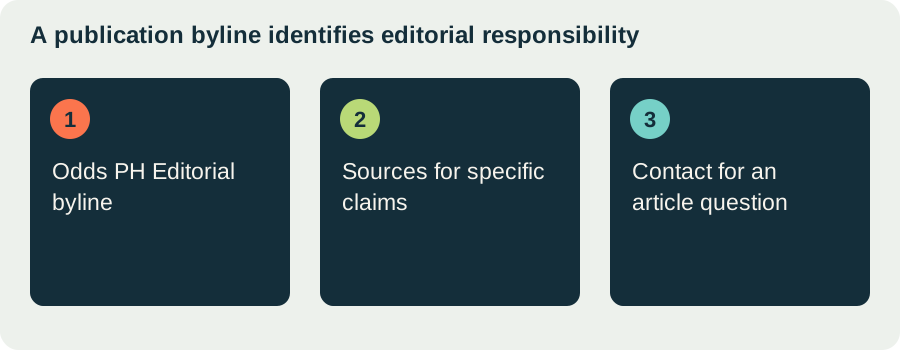
Odds PH Editorial is the publication byline for the website’s sports guides, athlete profiles and educational explainers. It identifies the publication responsible for the article rather than an individual athlete, coach or reporter.
Coverage
The editorial material covers Philippine and international sport: PBA and NBA basketball, PVL volleyball, boxing, tennis, pickleball and Philippine athletes. Practical guides explain scoring, statistics, match times and odds mathematics through sources and worked examples.
Research and preparation
Articles are prepared with AI assistance and checked against cited sporting records and official guidance. The byline does not claim that an author witnessed an event, interviewed a player or personally tested a service. Individual expertise or first-hand reporting is credited when it is specifically identified.
Case: a byline beside a statistical explanation
Suppose a reader opens a basketball guide credited to Odds PH Editorial and notices a comparison of two fictional players. The publication credit identifies who presents that comparison. The player names, numerical inputs and conclusion must be read within the example, rather than assumed to describe people known to the writer. A collective byline does not supply an additional real-world participant hidden behind Team A or Player B.
The reader can ask a specific accountability question: does the conclusion follow from the stated inputs? If the table shows one attempt total and the sentence uses another, the concern is the publication’s presentation of its own illustration. No access to a real player’s private record or an actual betting account is needed to identify that mismatch. The article itself supplies the relevant material.
If the arithmetic is sound but the comparison is applied to a real athlete in a shared message, check what the original article actually identified as real. The byline remains attached to the explanation that was published. It should not be used to give an invented real-player claim the authority of a different, correctly labelled hypothetical example.
Case: a source name is mistaken for an interview credit
A reader might see a tournament’s name linked beneath an athlete profile and infer that the tournament supplied an interview to Odds PH. A source link alone does not establish that. A public tournament record can support a title or appearance without supplying personal testimony. The publication byline credits the explanation here; any claimed interview needs its own specific attribution.
Compare two kinds of statement. “The tournament record lists a title” attributes a sporting record to its organiser. “The player explained a training decision in an interview” attributes speech to a person and an interview. The second cannot be inferred from the first, even if both would fit naturally in the same profile. The credit should follow the actual kind of material involved.
If you want to ask about a quotation or personal account, identify the exact passage rather than asking generally who wrote the website. That focuses the question on whether a person was quoted, whether another publication’s interview was being discussed or whether the sentence was the publication’s own explanation. It avoids turning a familiar organisation name into a first-hand reporting claim that the article never made.
The claim matters more than an impressive-sounding label
A publication name is not a substitute for evidence. For an explanatory guide, useful questions include whether a term is defined correctly, whether an example adds up and whether the cited rule applies to the competition discussed. A reader can inspect those things without assuming that a collective name carries the credentials of an unidentified coach, statistician or official. Specific expertise should be credited specifically when it is being relied upon.
A statement about personal observation needs a different basis from a calculation. Attending a match, interviewing a player and personally testing a subscription are experiences, not qualities that can be inferred from an author label. Unless an article expressly identifies that first-hand work, the publication credit should not be read as a claim that it occurred. Our guides distinguish public sporting records and explanation from such individually attributable experiences.
This is particularly helpful when an article is shared without its surrounding page. A familiar publication credit can tell another reader where the explanation came from. It cannot, on its own, prove a newly added claim in the message forwarding it. Keep the original statement and its qualifications visible so that the credit continues to identify the material actually published, rather than a stronger assertion someone has attached to it.
Responsibility for an original worked example
Worked examples belong to the explanatory part of the article. If a guide describes fictional Teams A and B, the scores illustrate a relationship within the rules or arithmetic. They are not league records supplied by a hidden source. The publication is responsible for making the scenario understandable and for keeping the invented nature of the numbers clear. A reader should be able to use the calculation without mistaking it for a real fixture.
Consider a comparison in which one fictional player makes the same number of baskets as another but needs more attempts. The example can demonstrate why a scoring total and a conversion rate are different measures. It does not establish which real player is better. Removing the words that identify the illustration as hypothetical changes the claim, even if the numbers themselves have been copied accurately.
When referring to such an example elsewhere, preserve the purpose as well as the credit. “Odds PH uses a fictional game to explain a quarter-by-quarter comeback” accurately describes an explanatory asset. Presenting that game as an actual result would attribute something different to the publication. The distinction is simple, but it protects both the reader’s understanding and the athlete or team that might otherwise be incorrectly associated with an invented performance.
Case: two guides mention the same player for different reasons
A reader may see Odds PH Editorial on both an athlete profile and a guide to reading a tournament draw. In the profile, the player’s dated achievement can illustrate a career milestone. In the draw guide, a player or fictional slot can illustrate progression through rounds. The shared byline does not mean the two pages make the same claim about the player’s next match.
Identify the statement you are asking about. “Was this a senior title?” concerns the achievement described in the profile. “Does this draw position establish an opponent?” concerns the tournament explanation. That distinction keeps a question about authored content precise without repeating the full biography or competition guide on this page.
Case: a reader wants to know whether a specialist reviewed a claim
A collective publication credit is not a named coaching, refereeing or medical qualification. If a reader sees a guide to boxing scoring and wants to know whether a particular official reviewed it, that is a specific question about a review credit. The byline alone does not identify such a reviewer. Any individually attributed expertise needs the person’s name and the role relevant to the statement.
For example, an explanation can be supported by a governing body’s published rules without having been personally approved by one of its officials. Those are distinct forms of support. The article’s reference to the rules should not be expanded into a claim that the organisation or an unnamed specialist endorsed the publication’s interpretation.
The useful reading is the one the visible credit supports: Odds PH presents the guide, its cited records support particular facts and any separately identified specialist credit applies to its stated contribution. If a question concerns whether the rule was interpreted correctly, raise that interpretation directly. An assumed credential should neither replace the evidence nor be introduced simply because the subject involves expert work in the actual sport.
Case: an article is quoted without its conditions
Imagine a reader sharing a passage from a guide about a tennis appointment. The passage describes an earliest start, but the shared message drops the words “not before” and presents the time as guaranteed. The publication credit on that message does not make the stronger statement part of the original article. The condition changes the meaning, even though the hour has been copied correctly.
When referring to the article, include enough of the passage to preserve the question it answers. The same applies to a hypothetical price, a dated achievement or a scoring rule limited to a particular competition. A page address lets another reader inspect that context; the article title helps identify which explanation was intended. Neither requires treating the byline as a guarantee about a statement added elsewhere.
If a shared quotation appears different from the current wording, identify the version or saved passage you saw. That gives a discussion a concrete reference. It is more useful than attributing an impression to the publication as a whole, especially when several guides mention the same athlete, game or number for different reasons.
Case: an illustrated figure appears beside an athlete profile
Keep that distinction when sharing a page image. Credit for an explanation does not imply that the athlete posed for its artwork or endorses an adjacent advertisement. Identify the actual image if it appears misleading; the byline identifies the publication to which that question can be directed.
Case: a reader challenges the publication’s interpretation
A reader can accept a sporting record while disagreeing with the explanation built around it. Suppose a recap identifies a decisive stretch of a fictional game, but the reader thinks a different sequence better explains the outcome. The disagreement concerns the interpretation and its reasoning, rather than who officially won. The byline identifies the publication presenting that reasoning.
Make the point concrete: identify the passage and the evidence that seems to support another reading. A disagreement about an arithmetic total, the meaning of a rule or a tactical explanation should not be bundled into one general accusation that the result is wrong. Separating those concerns makes it possible to discuss exactly what the publication has stated.
This does not promise a particular reply or outcome. It identifies the responsibility attached to the credit: a question about the article belongs with the publication, while a request to change an official competition record belongs with the organisation responsible for that record. The corrections page provides the separate reporting route; this byline page explains which authored explanation a reader is addressing.
Identifying the version of an explanation you mean
If an article has been updated, include its page address and the date or passage you are discussing. A saved quotation can describe an earlier version while the current page contains a more complete explanation. That is different from two publications disagreeing about the same statement.
The publication credit remains a useful reference, but the exact passage makes the question answerable. It lets a discussion focus on what was stated and how its evidence applies, rather than on a general impression of an article that may have changed.
Case: a promotional button appears near the byline’s article
A reader can see the Odds PH Editorial credit on a sports guide and a separate offer farther down the same page. The credit identifies the article’s publication, while the advertisement label identifies the commercial message. A promotional button should not be quoted as though it were the article’s sporting conclusion. The distinction remains important even when the illustration and surrounding article concern a similar sport.
For a question about that page, identify the element concerned. A sentence interpreting a score, a button inviting a commercial action and an outside service’s account condition are different statements. The publication can be asked about the wording it displays, without the byline being treated as the outside service’s customer-support identity.
The advertising disclosure explains the separate commercial relationship. Keeping the authored explanation and the labelled promotion identifiable helps a reader attribute the right claim to the right part of the page.
Contact and accountability
Email [email protected] for editorial questions. For an error report, include the page, the statement concerned and the source supporting a correction. Read the editorial standards and corrections policy for more detail.