
Responsible gambling begins with the option not to gamble
You can follow sport, learn how odds work and enjoy the discussion around a match without staking money. Understanding a price is not a reason to participate. No amount of sporting knowledge makes a result certain, and a correct calculation does not make a possible loss affordable.
This page explains ways to recognise pressure, create distance from gambling and seek appropriate support. It does not diagnose a condition or guarantee that a particular limit will prevent harm. If gambling is affecting money, relationships, sleep or other responsibilities, those effects deserve attention even when no one has used a clinical label.
Harm is not measured only by the amount lost
The World Health Organization’s gambling fact sheet describes financial, relationship and health harms, including effects on people close to the person gambling. It also notes that harm can occur below a clinical threshold. Waiting for a particular debt or loss to appear is therefore not a necessary first step before asking for help.
A person might be losing sleep checking results, hiding spending, missing family commitments or repeatedly using money intended for another purpose. Someone else might be distressed by uncertainty about a shared account. These are different experiences, but both can justify a conversation and practical support.
Notice patterns rather than trying to award yourself a score
GamCare’s signs-of-harm information identifies patterns such as chasing losses, secrecy and withdrawing from ordinary activities. A short list is a prompt to reflect, not a diagnostic test with a pass mark. The absence of one sign does not cancel the importance of another.
- Are you spending more time or money than you intended?
- Are you trying to recover losses rather than enjoying the sporting event?
- Are bills, food, transport or other essentials being delayed?
- Are you hiding activity, amounts or borrowed money?
- Do you keep checking odds or results when you meant to work, study or rest?
- Do attempts to stop repeatedly become another reason to continue?
Write down an actual example rather than labelling yourself. “I used money set aside for a bill” is a clear observation. “I should be stronger” is a judgment that does not explain the next practical step. A trusted person or qualified support professional can help you work with the observation.
Chasing losses changes the reason for the next decision
Chasing means continuing or increasing gambling in an attempt to recover money already lost. The next stake may feel necessary because of the earlier result, even though that loss does not improve the next event’s chance of success. The pressure can shift attention away from the amount newly exposed.
Imagine a fictional person who planned to stop after a match, loses, and then opens another event only to get back to the starting balance. The new event was not part of the original plan. Its potential payout now has to carry the emotional weight of an earlier loss. The useful response is to create distance from that pressure, rather than treating another calculation as a recovery obligation.
Protect essential money without turning a limit into a target
Money needed for housing, food, utilities, healthcare, education, transport and debt repayments should not become a gambling stake. Borrowing or using credit adds a separate repayment problem without making the sporting result more predictable. PAGCOR’s responsible-gaming reminders emphasise that gambling is not income, that money should not be borrowed for it, and that losses should not be chased.
A limit is a boundary, not an amount that must be used. Spending less or nothing does not mean missing an entitlement. If you repeatedly break a limit, the answer is not automatically a larger one. Consider stopping and adding support or stronger barriers instead of renegotiating the boundary while under pressure.
Use time as well as money to notice the impact
A session can affect daily life even when its immediate financial result is small. Repeated checking, lost sleep and distraction can take attention from work, study or relationships. Record the time spent looking at promotions and results as well as the time spent placing selections, if doing so helps you see the whole pattern.
A planned break can include putting the phone away, leaving the screen and doing an activity unrelated to the next result. If every pause turns into another check, that observation matters. A clock reminder is one tool; it is not proof that the activity is under control.
Create distance when an urge feels immediate
If you feel driven to continue, stop opening new markets and step away from promotional content. Contact someone you trust and describe what is happening in plain terms. You can say, “I am feeling pressure to win back a loss and need help taking a break.” You do not need a complete explanation of every past decision to begin that conversation.
The GamCare harm FAQs discuss creating distance and seeking support. Their service arrangements are UK-based, so check a support service’s location and eligibility before assuming it offers personal care in the Philippines. General educational information and a locally available support appointment are different things.
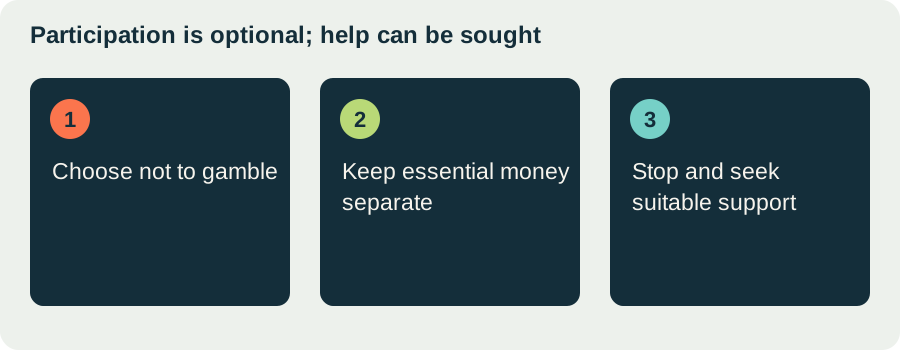
Understand the different kinds of access control
| Tool | What to establish | Important limitation |
|---|---|---|
| Account break or time-out | Which account and period it covers. | It may not cover other services. |
| Self-exclusion | The formal application, duration and participating services. | Read the applicable scheme, not a description from another country. |
| Device or website blocking | Which devices and access routes are included. | It is a barrier, not a complete support plan. |
| Payment controls | What the payment provider actually offers. | Availability and coverage vary. |
Use the provider’s genuine process and keep its confirmation. Avoid trying to evade a restriction through another account, device or payment method. If a barrier is not working as expected, contact the relevant provider rather than treating the gap as a reason to resume.
Find Philippine exclusion information at its source
PAGCOR publishes responsible-gaming and player-exclusion information, including an online self-exclusion application route. Use its current official responsible-gaming page to read the available process and requirements. A general article should not substitute an old form, a remembered duration or another country’s scheme for those current instructions.
If a relative is seeking information, distinguish self-exclusion from any family-initiated procedure. Who may apply, what information is required and which services are covered are questions for the applicable official process. Do not send identity documents to an unrelated sports publication or a person claiming to arrange exclusion privately.
Reduce promotional pressure
Promotions can create a feeling that a decision must be made now. A countdown, expiring token or personalised message does not create a duty to participate. You can leave an offer unused. If gambling is causing harm, completing an offer’s conditions is not a more important goal than stopping.
Review the marketing choices available in the services you use and consider removing gambling apps or promotional notifications from everyday view. Different tools cover different channels, so check what actually changed. Our promotion-conditions guide explains offer vocabulary; it is not an instruction to claim an offer or complete its wagering.
Keep sport available without the betting layer
Try following the match through an official scoreboard, a rights holder’s coverage or a sporting discussion that does not revolve around wagers. You can keep a personal note about a player’s performance, a tactical change or a scoring rule instead of a running money result.
For example, choose one volleyball reception pattern or a basketball statistic to understand during the next game. The aim is to give your attention a sporting question with an answer independent of a payout. If the betting association remains a strong trigger, a longer break from that content may be more useful than trying to stay close to every fixture.
Talk to someone with a specific request
Choose a calm, private time and describe the effect you want help addressing. “I have been hiding spending and want support stopping” gives the other person something concrete to respond to. You can ask them to stay with you while you contact an appropriate service, help organise essential bills, or check that you follow through on an account restriction.
You do not need to hand over secret account codes as proof of honesty. Agree how financial information will be handled and use safe, legitimate account procedures. A support conversation should reduce isolation and clarify the next step, rather than create another setting in which someone can misuse an account.
If someone close to you is affected
Talk about observations rather than accusations: missed bills, concealed spending or repeated requests for unexplained money. Listen to the response, while keeping your own boundaries clear. You can care about the person without agreeing to lend money for another attempt to recover losses.
GambleAware NSW’s information for family and friends explains why changes in money, routines and relationships can matter. Its local support arrangements are Australian. For personal assistance in the Philippines, check the availability of a qualified local service rather than assuming a foreign programme applies.
Prepare for a support appointment without diagnosing yourself
A short private note can list the effect on daily life, attempts to stop, recent pressure to continue and the kind of help you want. Take only the information the service asks for through its genuine process. You do not need to calculate a severity score or arrive with a diagnosis.
Ask what the service provides, whether it supports people in your location, how appointments work and how personal information is handled. Counselling, financial guidance, formal exclusion and transaction support are different services. A single contact may guide you to another source of help for part of the problem.
A setback is a reason to review the plan
If you gamble after deciding to stop, avoid treating the episode as proof that further gambling no longer matters. Step away again, tell the person or professional supporting you, and review what happened before the decision. Was a notification, an available account, a familiar routine or financial pressure involved?
The purpose is to identify a practical gap, not to build a story of personal failure. A plan may need another barrier, a different routine or more support. Do not try to repair the setback by winning money back. That repeats the pressure the plan was meant to address.
Read an activity statement as a record, not a challenge
If reviewing an account’s financial effect, distinguish deposits, withdrawals and the cash remaining. A deposit is a transfer into the account; it is not automatically the amount lost. A withdrawal is money returned from the account; it is not automatically all profit. Open selections, restricted balances and fees can complicate a real statement, so keep their labels separate.
In a simplified fictional cash-only example with no open selections or fees, an account starts with 50 units, receives 100 more, pays out 20 and ends with 30. The reduction attributable to activity is 50 + 100 − 20 − 30 = 100 units. Looking only at the 20 withdrawn could give a very misleading impression of the overall position.
The purpose of a record is to make the effect visible. It is not an amount that another session must recover. If reviewing the figures creates a strong urge to continue, stop the review and involve someone appropriate to support you.
Agree boundaries in a supportive conversation
A trusted person can help without becoming an unofficial account operator. Discuss what you are asking them to do: accompany you to an appointment, help keep essential payments organised or check in after a difficult fixture. Agree what information is needed and what remains private.
For the person offering support, a clear boundary might be helping with an essential bill through an agreed arrangement while declining to fund gambling. Avoid promising that one conversation will resolve the situation. Keep the next step small enough to carry out, and seek qualified guidance when the problem involves health, debt or personal safety beyond what a friend can manage.
How Odds PH’s information fits
Our odds explanations describe probability and payouts, and the calculator performs arithmetic without placing a bet. Neither can assess personal wellbeing, affordability or eligibility. Partner advertisements are intended for eligible adults aged 21+; seeing one does not establish that participation is appropriate for a particular reader.
For an unclear claim in our content, contact [email protected]. Do not send passwords, OTPs, identity documents or financial records to that editorial address. We cannot provide counselling, access an account or operate an exclusion process on your behalf.