
Decimal odds calculator
Enter a decimal price and a hypothetical stake to compare implied probability, total return and net profit.
Use the formulas below if the interactive calculation is unavailable.
How to use the decimal odds calculator
Enter the price in decimal format, such as 1.80 or 2.50. Enter a hypothetical stake in units: 100 units makes the maths easy to compare, but it is not a suggested stake. Press Calculate to see the implied probability, total return if successful, net profit if successful and loss if unsuccessful.
The optional opposing-price field calculates the excess probability in a complete two-outcome market. Leave it blank if you only want a single-price calculation. It is not a field for an unrelated match, a second leg in an accumulator or a third possible result.
- Check that you have decimal odds, rather than a fraction or an American price.
- Use the same hypothetical stake when comparing two prices.
- If adding opposing odds, confirm both selections belong to the same market and cover every possible outcome.
- Read return, profit and probability as separate outputs.
Worked example: odds of 2.50 and a 100-unit stake
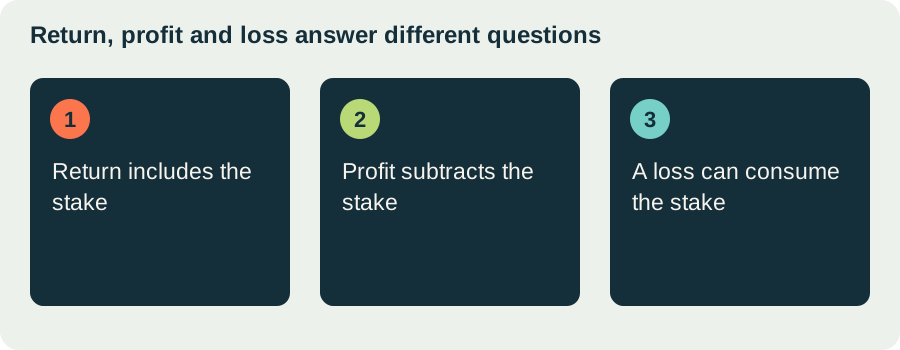
At the default inputs, implied probability is 100 ÷ 2.50 = 40%. Total return on a successful selection is 100 × 2.50 = 250 units. Subtract the original 100-unit stake to obtain 150 units of net profit. If the selection loses, the loss is 100 units.
Change only the odds to 1.80, keeping the stake at 100. The implied probability becomes 55.56%, return becomes 180 units and profit becomes 80 units. The smaller payout does not change the amount at risk. All of these figures describe a hypothetical ordinary single selection before fees or other deductions.
| Decimal odds | Implied probability | Total return if successful | Net profit if successful |
|---|---|---|---|
| 1.50 | 66.67% | 150 units | 50 units |
| 1.80 | 55.56% | 180 units | 80 units |
| 2.00 | 50.00% | 200 units | 100 units |
| 2.50 | 40.00% | 250 units | 150 units |
| 4.00 | 25.00% | 400 units | 300 units |
The formulas behind each output
- Implied probability (%) = 100 ÷ decimal odds.
- Total return if successful = stake × decimal odds.
- Net profit if successful = stake × (decimal odds − 1).
- Loss if unsuccessful = the hypothetical stake.
- Two-outcome overround excess = (100 ÷ first odds) + (100 ÷ opposing odds) − 100 percentage points.
The displayed answers are rounded to two decimal places. Intermediate calculations keep more precision, so adding two rounded percentages by hand may differ by 0.01 from a rounded total. Zero is permitted as a hypothetical stake: return, profit and loss will all be zero, while the price’s implied probability stays the same.
Calculate a two-outcome margin
Try a first price of 1.90 and an opposing price of 1.90. Each implies approximately 52.63%. The complete book is approximately 105.26%, and the calculator displays 5.26 percentage points as the excess above 100%.
That excess is a way to describe market pricing; it is not the operator’s realised profit and not your personal probability of losing. An unequal pair of prices can also produce an overround. At 1.80 and 2.20, the total is about 101.01%, leaving an excess of 1.01 percentage points. Our guide to implied probability and bookmaker margin explains the interpretation.
When the opposing-price calculation is inappropriate
A market with a draw has three outcomes, so two prices are insufficient. Prices from different points in time may never have been simultaneously available. Prices for regulation-only play cannot be mixed with a selection that includes overtime. Two competitors appearing in the same fixture is not enough to establish that two particular markets are exact opposites.
A negative calculated excess can be caused by mismatched or incomplete inputs. It does not establish an executable arbitrage or a guaranteed profit. Availability, limits, fees and the operator’s settlement conditions are outside this calculation.
What this calculator does not include
The tool does not model accumulators, exchange lay liabilities, each-way terms, free-bet settlement, cash out, tax, deductions or commission. It also does not determine whether an interrupted event is void or whether a handicap produces a push. Those questions require the exact market rules.
Most importantly, implied probability is derived from a price. It is not an independent assessment of form, injuries or the likely winner. A larger number in the return field means a larger conditional payout, not a safer selection.
Start with an input record, not a remembered number
For a useful comparison, write down what the price belongs to before entering it: the event, selection, market definition and time it was observed. The calculator reads the number you type, not the meaning of the label beside it. Entering 2.50 from a first-set market while thinking about the full match produces accurate arithmetic for the wrong question.
Keep this record outside any private account details. You do not need a wallet balance, password or account reference to calculate a multiplier. A fictional quantity is sufficient. If you are comparing two displayed prices, use the same market conditions and hypothetical stake so the output changes reflect the price rather than a change in what you entered.
Example: isolate the effect of the price
Enter 2.20 and a hypothetical stake of 50, leaving the opposing field blank. The implied probability is 45.45%, total return on success is 110 units, and profit on success is 60. Now change only the price to 2.40. The probability becomes 41.67%, return becomes 120, and profit becomes 70.
| Price | Stake | Return on success | Profit on success | Loss on failure |
|---|---|---|---|---|
| 2.20 | 50 | 110 | 60 | 50 |
| 2.40 | 50 | 120 | 70 | 50 |
The second price pays ten units more if successful, while the hypothetical amount exposed remains 50. It does not tell you which underlying outcome is more likely. If the two prices refer to different markets, the table is only a comparison of multipliers, not evidence that one offer is preferable for the same selection.
Example: isolate the effect of the hypothetical stake
Keep the price at 2.20 and change the hypothetical stake from 50 to 75. Return becomes 165 units and profit becomes 90; loss on failure becomes 75. The implied probability stays at 45.45%. Multiplying the quantity by one and a half has multiplied the conditional monetary outputs by the same factor, without changing the price’s implied chance.
This is a checking exercise, not a suggested amount. If increasing an input makes a possible return look more attractive, read the loss field at the same time. A calculator can display a larger upside and a larger amount exposed together. Neither output grants permission to use money needed for essentials.
Example: a zero-stake check
With a price of 3.25 and a stake of zero, the return, profit and loss outputs are all zero. The implied probability is approximately 30.77%, because that calculation depends on the price alone. This is a useful way to inspect the percentage without assigning any amount of money to the example.
Zero does not represent a special free-bet settlement mode. It is simply zero in an ordinary multiplication. A promotional token can have conditions that are not modelled here. If you need to understand one, read its funding and settlement terms rather than trying to create it by entering a zero cash stake.
Example: inspect the two-price output carefully
Enter 1.60 as the first price and 2.50 as the opposing price for a hypothetical complete two-outcome market. Their implied probabilities are 62.50% and 40%, totalling 102.50%. The two-outcome overround output is the 2.50 percentage-point excess, not the complete 102.50% book.
Now clear the opposing field and calculate again. The optional market output should no longer be part of the new result; the single-price outputs still describe 1.60. Clearing a field is different from typing zero. Zero is not valid opposing decimal odds, while a blank optional field means that you are not requesting that calculation.
Check an output with a simple manual calculation
Choose a hypothetical stake of ten and decimal odds of 2.75. Ten multiplied by 2.75 gives a total return of 27.50. Subtract ten to obtain profit of 17.50. The implied probability is 100 divided by 2.75, approximately 36.36%. These independent checks can help you identify whether a surprising output comes from a mistaken input or a misunderstanding of the label.
For the optional margin, calculate each percentage before adding. Do not add the odds and divide 100 by that sum. At 2.00 and 2.00, the correct calculation is 50% plus 50%, leaving zero excess. Dividing 100 by four would give 25%, which answers a different calculation and is not the book’s excess.
Why rounding can create a one-hundredth difference
The display rounds results rather than asking you to work with every decimal place. Suppose each of two prices is 1.80. Each individual implied percentage rounds to 55.56%, so adding the displayed values produces 111.12%. Using the unrounded values first produces approximately 111.1111%, which rounds to 111.11%.
Input problems to resolve before calculating
- A fraction in a decimal field: convert a price such as 7/4 to 2.75 before entering it.
- An American price: +175 also becomes 2.75; entering 175 alone would describe a radically different decimal multiplier.
- A currency symbol inside the number: the numeric stake field expects the quantity, not a written currency label.
- A comma used as a thousands separator: make sure the field has accepted the intended number, especially on a phone with local number formatting.
- A missing required value: enter both the decimal price and the hypothetical stake; the opposing price is optional.
If a field shows an error, resolve that field rather than assuming an older displayed answer belongs to the new inputs. Read the numbers actually visible in the form before pressing Calculate again. The tool’s accepted numeric ranges are input limits, not a recommendation to use their largest values.
If the interactive form is unavailable
The formulas and reference examples remain useful without operating the form. You can calculate return by multiplication, profit by subtracting the hypothetical stake, and implied probability by dividing 100 by the decimal price. No account or payment is needed to use those explanations.
If the controls do not become available in your browser, do not send account information to get them unlocked. This page does not need access to a betting account. Use the written worked examples, or a basic calculator, while keeping the assumptions visible. A technical problem with an educational form says nothing about the status of a wallet or a real selection.
Read the output before drawing a conclusion
Check four labels in order: the implied percentage, total return on success, net profit on success and loss on failure. Then inspect any optional market output. This prevents the largest displayed number from becoming the only one you notice.
For longer explanations of why a price is not an independently known probability and why an overround is not realised profit, use how odds work. This page is for checking the calculation you entered. It does not supply a forecast, choose an operator, resolve an account dispute or recommend increasing a stake.
One calculation is not an account statement
The output describes one hypothetical selection. It does not add earlier deposits, withdrawals, other wins or losses. If a return of 110 units appears for the current inputs, that does not mean an account has gained 110 overall. The original stake and any other transactions belong to separate records.
For a comparison exercise, keep one row per set of inputs: decimal price, hypothetical stake and calculated outputs. This makes it possible to reproduce the result later without mistaking a figure copied from another scenario for the one currently on the screen.
Frequently asked questions
Do I enter pesos or another currency?
The arithmetic is currency-independent. The output uses units so that 100 can represent a purely hypothetical quantity. If you interpret it as pesos, the multiplier works the same way; actual settlement can involve additional terms.
Why are odds of 1.00 rejected?
This tool accepts decimal prices greater than 1.00. A 1.00 multiplier would merely return the stake on success and would not behave like the ordinary winning prices illustrated here.
Can I use a fraction such as 3/2?
Convert it first: 1 + 3 ÷ 2 = 2.50. Positive American odds of +150 also correspond to 2.50. See the odds-format comparison for more examples.
Does using the tool place a bet?
No. Calculate changes the displayed arithmetic only. Understanding a payout does not remove the risk of losing money.