
How advertising supports Odds PH
Some Odds PH pages display partner advertisements. The publication may receive a commission when a reader follows an affiliate link and completes qualifying activity with the partner. That commercial relationship is the reason for this disclosure. It is separate from the sporting facts discussed in the article surrounding the advertisement.
You can read a basketball guide, learn volleyball scoring or check a hypothetical calculation without taking up an offer. A banner is a paid commercial invitation, not the next required step in understanding an article. The presence of an advertisement does not turn the publication into the operator of the destination account or make a sporting organisation responsible for the offer.
This page explains how to recognise the relationship and assess what the placement does and does not establish. For the scope of the promotion wording itself, use the partner promotion notice. For questions about an individual commercial disclosure on Odds PH, contact [email protected].
Advertising, affiliate links and sporting sources
A link can have different purposes. A source link helps you inspect a league record, rulebook or announcement. A related-article link helps you continue reading within Odds PH. An affiliate advertisement promotes a commercial service and can create a commission relationship when qualifying activity follows. The fact that all three can be clicked does not make their purpose identical.
For example, a link to the official NBA scoring rules supports an explanation of a three-point basket. It does not advertise a welcome bonus. A partner banner placed near that explanation serves a different purpose, even if its illustration also uses a sporting theme. Read the label and the destination rather than inferring the relationship from the surrounding colours or imagery.
The distinction is useful when sharing a page. Quoting a worked score does not mean you are recommending its advertiser. Equally, an advertisement should not be described as a league announcement merely because it appeared beside one. When discussing a particular statement, identify whether it came from the article, the advertisement or the outside service reached after a click.
What a commission means for the reader
A commission is a commercial payment associated with qualifying activity. It does not establish that the reader has gained an advantage or that the promoted service will produce a favourable result. The partner’s actual eligibility and promotion rules determine whether a particular reader qualifies for an offer. Our disclosure is not a substitute for those conditions.
Do not assume that the word affiliate describes one universal payment arrangement. Some commercial relationships in publishing are associated with a registration, a purchase or another qualifying action. That general explanation does not identify a particular commission rate or trigger for every placement on this website. We do not publish invented commission figures to make an offer seem more transparent than the available information supports.
Consider a hypothetical comparison between two services. A publisher could have a commercial relationship with one and no relationship with the other. That difference explains an incentive, but it does not by itself settle which service has better terms. The reader still needs the actual features, restrictions and costs relevant to the decision. Disclosure makes the incentive visible; it does not replace evidence.
How partner placements are identified
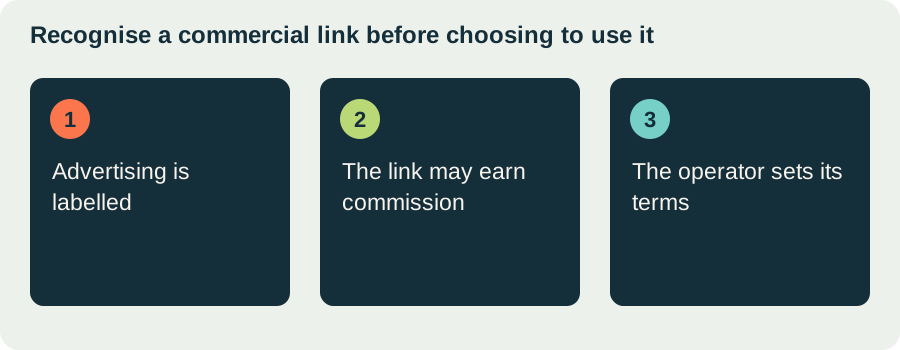
Partner banners on Odds PH carry an advertisement label and an age notice. Their commercial headline and action button distinguish the offer from the surrounding sporting explanation. Links to disclosures and promotion information give the reader a route to more context before deciding whether to continue.
The label matters even when the design matches the website’s colours. A polished illustration, a readable headline and a familiar button style can make a placement visually coherent without making it editorial advice. If an advertisement is unclear, the useful question is not simply whether it looks attractive; it is whether a reader can understand who is speaking and why the link is present.
The FTC’s native-advertising guidance discusses the problem of advertising that resembles surrounding content. That US guidance is included as background on recognising commercial messages, rather than as a claim that one jurisdiction’s rules settle every reader’s situation. Our own placements are identified as advertisements on the page.
Athlete profiles do not imply endorsements
An athlete can be the subject of a sporting article without having any relationship with an advertisement on the same page. Alexandra Eala’s tournament results, a Philippine athlete’s medal and a team’s championship record are sporting information. None of those facts establishes that the athlete recommends a betting service.
The illustrated models used in partner banners are fictional. They are not photographs of Alexandra Eala or another real athlete, and the artwork should not be interpreted as a personal endorsement. The same distinction applies to familiar equipment or a court setting: a tennis racket in an illustration does not identify a particular tournament as a sponsor of the offer.
When evaluating an endorsement claim elsewhere, separate a verified statement by the person from an image placed beside commercial text. A fan page, a repost or a sporting nickname can create an association in the reader’s mind without establishing permission or a real business relationship. If an Odds PH placement appears to imply such an association, identify the page and the specific feature in your report.
A headline is not the full promotion
A welcome-bonus headline communicates the broad subject of an advertisement. It does not specify every qualifying deposit, wagering condition, expiry date, excluded market or withdrawal restriction. A free-bet button likewise does not establish an unconditional cash payment. Read the destination’s current terms before interpreting the headline as an exact account entitlement.
For an original example, imagine a hypothetical offer that mentions a free bet in its headline but requires qualifying activity in its full conditions. Comparing it with a cash discount simply by looking at the largest displayed number would miss a difference in how the benefit works. The appropriate comparison is the actual entitlement, its conditions and whether it is relevant to you.
This example is not a description of an additional Odds PH offer or a claim about the terms of the current partner. It explains why a short advertisement and a complete promotion notice answer different questions. The publication does not fill a gap in the source material by inventing a bonus amount, wagering multiplier or payment guarantee.
Editorial explanations and commercial incentives
An explanation of a rule should remain useful if the advertisement is removed. A box-score calculation can be checked from its stated inputs. A volleyball example can be understood from the set totals. A boxing scorecard can be added without opening a commercial account. Those are appropriate tests of whether the article provides information independently of the placement.
Commercial relevance is not evidence of expertise. A service paying for attention does not establish that it has assessed the sporting analysis, and a publication carrying an advertisement should not present the payment as certification of its own knowledge. Look for the actual record and reasoning behind a claim rather than treating a commercial association as its proof.
Our editorial policy explains source checking and the distinction between recorded facts, interpretation and hypothetical examples. This funding disclosure addresses the commercial relationship. The two pages are connected, but the explanation of how an article is prepared is not replaced by the explanation of why an advertisement appears.
What evidence a commercial comparison needs
A useful comparison identifies the question being answered and the features that matter to it. Availability, eligibility, price, restrictions and the procedure for obtaining the advertised benefit are separate features. A service can have a relevant feature and still be unsuitable for a particular reader because another condition prevents access.
For a hypothetical example, one offer might use a longer qualification period while another has a narrower eligible market list. The longer period alone does not establish which offer is better. A comparison should say which conditions differ and why they matter, instead of presenting a single decorative score as a complete conclusion.
First-hand testing also has a specific meaning. It requires an actual test and an explanation of what was done. A description taken from an operator’s website is not the same as a personally observed registration or withdrawal. Odds PH does not turn an unperformed test into a favourable rating. When the evidence only supports a description of published terms, the claim should remain at that level.
After a reader follows an advertisement
Following a partner link opens a separate commercial destination. That service controls its registration, verification, account access and settlement procedures. Its privacy policy governs information supplied there. Odds PH cannot inspect an individual partner balance or change the service’s decision about a promotion.
An account question and an advertising question therefore need different routes. “The banner headline is unclear” concerns the publication’s placement. “My account has not received a promotion” concerns the service holding the account and its actual conditions. Sending account credentials to the publication does not make the second issue easier to resolve.
Keeping financial risk in view
An advertisement is not a promise of income. A potential payout is conditional on an outcome and subject to the relevant rules. Even a correctly described offer does not remove the possibility of losing money. Understanding decimal odds and qualification terminology is different from being advised to participate.
The educational odds calculator checks hypothetical arithmetic. It does not connect to the partner or select a stake. A result such as 40% implied probability describes the entered price, not a personalised assessment of an individual’s circumstances. Do not use a neat calculation or an attractive banner as a reason to disregard financial pressure or exclusion conditions.
Partner advertisements are intended for eligible adults aged 21 or older under the service’s rules. The age notice is not a complete statement of eligibility. If gambling is causing harm, promotional material is not the appropriate next step. Read our responsible gambling information for the boundary between learning about odds and deciding to risk money.
A reader’s checklist for commercial claims
Before treating an advertisement as useful information, identify the service it promotes, the broad type of offer and where the complete conditions can be read. Distinguish an amount available only under conditions from money you already own. Check dates and availability rather than relying on a saved image from a previous campaign.
Next, consider which part of the surrounding page you are relying on. A sporting result should be supported by a sporting record. A product feature should be supported by the provider’s current information or a documented test. An endorsement should be supported by an actual statement or agreement, rather than the reader’s impression of a picture. Each claim needs the kind of evidence that could genuinely establish it.
Finally, decide whether the commercial information is relevant to your original purpose. If you came to learn why a match finished 3–2, the scoring explanation may answer your question completely. There is no obligation to continue to an offer after receiving that answer. A useful publication respects the distinction between informing a reader and inviting a commercial action.
Questions about this disclosure
For an enquiry about an Odds PH advertisement, email [email protected] with the page address and the wording or image feature you want clarified. State whether the concern is a missing label, an unclear headline, a suggested endorsement or a mismatch between the placement and the destination’s description. Different concerns require different evidence.
You do not need to prove a financial loss to identify an unclear disclosure. Equally, a disagreement about an account entitlement is not resolved merely by calling it an editorial issue. Keep the complaint precise and use the actual provider’s account-support route for matters it controls. The publication’s contact page explains the types of enquiry that belong here.
Coverage is not an instruction to become a customer
A reader can have a legitimate sporting interest in a topic without having a commercial interest in its advertisements. Following a Philippine player, comparing two teams or learning how a tournament works is a complete purpose in itself. The article should help with that purpose rather than describe the reader as unfinished until an account has been opened elsewhere.
Likewise, declining an advertisement does not make an editorial correction less valid. If the arithmetic in a guide is wrong, the relevant evidence is the calculation. If a source link is broken, the issue is the link. A reader’s status with a commercial partner is not needed to understand either concern. This is another reason to keep an editorial enquiry separate from private customer-account information.