
What these editorial standards mean for a reader
Odds PH publishes explanations of sport, sporting records and related calculations for readers in the Philippines. The editorial standard is that a reader should be able to understand what a statement means, where an important fact comes from and which part is the publication’s interpretation. A confident sentence should not hide uncertainty that changes the answer.
Different pages answer different questions. A player profile explains a career; a scoreboard guide explains the displayed record; a statistical example explains arithmetic. The standards below apply across those formats without pretending that they all provide live reporting. An article should be judged by whether it answers its stated question accurately and usefully, not simply by the number of sporting names it includes.
Recorded facts, interpretation and examples
A recorded fact identifies something established by the relevant record: a completed score, an announced competition format or a dated career achievement. Interpretation explains what that fact may mean. A hypothetical example creates a simplified situation to show a calculation or rule. These categories can appear in the same article, but they should remain distinguishable.
For instance, a fictional basketball line can demonstrate why made three-pointers are already included in total field goals. It should not be presented as a player’s actual performance. A genuine quarter score can establish when a margin changed, but it does not alone establish why a coach made a substitution. The explanation needs the appropriate evidence for the particular claim.
An opinion is also different from an official outcome. A boxing viewer can disagree with a round assessment while acknowledging the announced decision. Describing the disagreement precisely is more useful than silently substituting an unofficial score for the result. Readers should be able to tell whether they are looking at the official record, a calculation based on it or an interpretation that can reasonably be debated.
Choosing sources that can answer the question
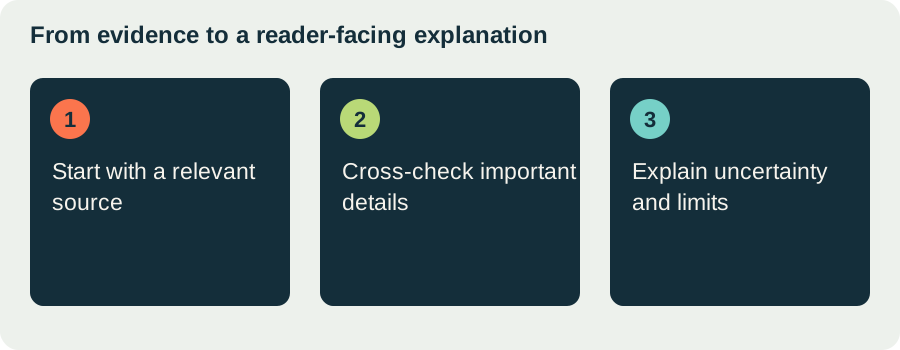
Odds PH uses leagues, governing bodies, tournament organisers and rights holders for the records and announcements they publish. The appropriate source depends on the question. A rulebook explains the scoring system. An order of play identifies a court and appointment. A player profile supports biography and career milestones, but may not contain a confirmed next-match time.
A primary source is useful because it is close to the record, not because it can never be wrong. A league can correct a statistical entry, a tournament can revise its schedule and an official biography can lag behind another published result. A source must therefore be read for its scope and date rather than treated as a permanent answer to every related question.
When an article combines records, it should preserve their differences. Club and national-team results are separate. Junior and senior achievements are separate. A season average and a single-game total are separate. Combining the labels without explanation can create a misleading claim even when each individual number was copied accurately. Our source directory helps readers locate the kind of record they need.
Dates, seasons and competition context
Dates do more than make an article look recent. They identify when a result happened or when a statement applied. A competition can change its format between seasons. A subscription feature can change between packages. A published ranking can differ from a live projection. An accurate explanation keeps the relevant time frame attached to the claim.
For international sport, the local event date and Philippine viewing date can differ. A US evening game can be watched the following morning in Manila. Reporting the Philippine appointment is useful, but it should not change the identity of the original game. A reader comparing records should still be able to find the same contest in the league’s own archive.
An article’s publication date describes when the page was published. Its update date reflects a meaningful content change, rather than the simple fact that the page was opened again. An evergreen explanation can remain useful without claiming that every linked score or schedule is continuously refreshed. When current information is needed, the relevant current source should be clear.
Handling conflicting information
A disagreement between sources is a reason to inspect the records, not an invitation to choose the most convenient number. First check whether the sources describe the same event, stage, date and measure. A match score and a series score can look contradictory while describing different levels of the competition. A full-game total and regulation-only total can differ because overtime was included in one.
If the disagreement remains, narrow the claim to what is supported. Two records may agree that an athlete won a title while differing on a displayed set score. In that situation, the title can be described without repeating the unresolved score. Leaving out an unnecessary disputed detail is preferable to presenting a guess as a confirmed fact.
Readers should also be able to recognise a change made after an official correction. A revised fixture is different from an error in the publication’s transcription. Both can require an update, but the explanation of what changed should preserve that distinction. The goal is an understandable record, rather than an appearance that the original information never differed.
Numerical examples and calculations
A worked example should identify its inputs, units and assumptions. A percentage without its denominator can be misleading. A payout without an explanation of whether it includes the original stake can be misunderstood. A ratio without a clear numerator and denominator can invite a comparison it cannot support.
In a basketball example, points, attempts and minutes should be read as different measures. In volleyball, rally points and sets should not be added as though they use one scale. In boxing, the judges’ individual cards should not be combined into a single giant total. The arithmetic can be correct while the interpretation is still wrong if those levels are confused.
Hypothetical examples are labelled and chosen to reveal the issue being explained. They are not predictions, records of a real athlete or evidence that a betting approach has been profitable. Rounding should not be used to manufacture a difference that disappears with the original values. If a conclusion depends on a simplifying assumption, the explanation should say so near the example.
What an explanation can and cannot establish
A useful guide explains the consequences of a rule or the limits of a statistic. It does not need to claim certainty about every sporting outcome. A strong performance in one match does not establish a permanent change in ability. A high scoring total does not isolate a player’s efficiency without considering opportunities and role. A short price does not turn a possible result into a guarantee.
Likewise, an article should not promise an answer that the available information cannot provide. An entry list does not establish a confirmed tennis opponent. An estimated ring-walk time does not create a fixed appointment. An old payment screenshot does not establish current access to a service. These are limits in the information itself, not gaps that can be safely filled with plausible wording.
The explanation should still help the reader act sensibly within that limit. It can identify the next record to check, show a correct calculation or clarify which comparison is valid. A page is more useful when it tells the reader exactly what a number establishes than when it repeats a broad warning without explaining the sporting question.
Attribution and first-hand claims
The publication byline Odds PH Editorial identifies the website responsible for its guides and explainers. It is not an invented individual identity. A byline should not suggest professional playing, coaching or reporting credentials that have not been identified, and an illustrated image should not be treated as evidence that a writer attended an event.
First-hand reporting has a specific meaning. Watching an event in person, interviewing a participant and testing a subscription are different activities, each requiring an actual basis. Reading another organisation’s report is not the same as conducting its interview. A description of published service features is not proof of a completed personal purchase or withdrawal test.
Named quotations should be traceable to the relevant source or interview. If an article instead explains a general concept, it should use its own explanation rather than invent a convenient expert quotation. Readers should not have to disentangle a fictional authority from the valid arithmetic or sporting rule underneath it.
AI assistance and accountability
AI tools assist in preparing research, drafts and calculations for Odds PH. They are not treated as a primary sporting record. An output can sound coherent while confusing a season, repeating an outdated rule or combining unrelated facts. Source-based checking and clear limits remain necessary when the explanation is written fluently.
Original examples and comparisons are used to make the subject understandable, rather than reproduce a source article with a few words changed. The important test is whether the explanation helps a reader solve the actual question: interpreting the score, understanding the format or checking a calculation. Decorative certainty and invented experience do not make the answer stronger.
AI assistance does not remove the publication’s responsibility for a factual concern. A reader should report an error through the same contact route regardless of how the initial wording was prepared. A named expert review is credited only when that reviewer is identified. The publication does not imply that an unnamed professional has reviewed every guide.
Sporting people and illustrative images
Editorial illustrations provide a visual setting; they are not documentary photographs of the event described. A stylised tennis figure does not establish that a named player posed for the website. Fictional models in advertising are separate from the real athletes covered in editorial articles. That separation is especially important when an advertisement appears near an individual profile.
Questions about names, achievements or image implications should identify the page and the precise concern. A familiar nickname or a circulating social graphic is not enough to establish a current official spelling or result. Use the relevant sporting record when comparing the publication’s wording with the source.
Advertising and editorial independence
Advertisements are labelled, and affiliate relationships are disclosed near relevant links. A payment does not establish the truth of a sporting claim, the quality of a service or the existence of an athlete’s endorsement. The article should answer its question without requiring the reader to open a commercial account.
A financial illustration in an odds guide is educational arithmetic, not personalised financial guidance. A commission relationship with an advertiser does not turn that illustration into a promise of profit. The funding disclosure explains the commercial relationship, while the promotion notice explains the limits of short offer wording. Neither should be substituted for the sporting evidence in an article.
Reporting and understanding corrections
For a factual concern, email [email protected] with the page address, the disputed statement and a supporting source where possible. Identify whether the issue concerns a recorded fact, an addition error, an unclear label or the interpretation of a rule. A precise report makes the concern easier to distinguish from a general disagreement with a sporting opinion.
Material factual changes are explained on the affected page. Spelling and layout improvements are different from corrections that change the meaning of a result or calculation. A reader comparing an older quotation with the current article should be able to understand a substantive difference rather than assume a new claim was always present.
Our corrections policy gives more detail about reports and the distinction between source updates and publication errors. Do not send passwords, payment credentials or identity documents with an editorial report. The record needed to check a sentence is usually the article and the relevant source, not access to the reader’s private accounts.
Comparisons and the examples left out
A comparison can mislead through selection even when every included fact is correct. Choosing only a player’s best matches, comparing one team’s long season with another team’s short run, or showing only successful predictions can create an impression the wider record does not support. The article should identify the period and basis of comparison when they materially affect its conclusion.
An explanation also needs an appropriate example. If the purpose is to show how a point deduction changes a scorecard, the example should make that deduction visible rather than quietly assuming it in the total. If the purpose is to compare two shooting lines, the relevant attempts and scoring values should be stated. Readers should be able to follow the reasoning without supplying an unstated favourable assumption. This is a standard for the quality of the explanation, rather than a claim that one example describes every sporting situation.