
Email Odds PH
[email protected] is the email address for questions about Odds PH articles, factual corrections, broken links, unclear explanations and publication enquiries. Include the page you are referring to when there is one. A precise message makes it easier to understand the request without asking you to repeat the whole sporting story.
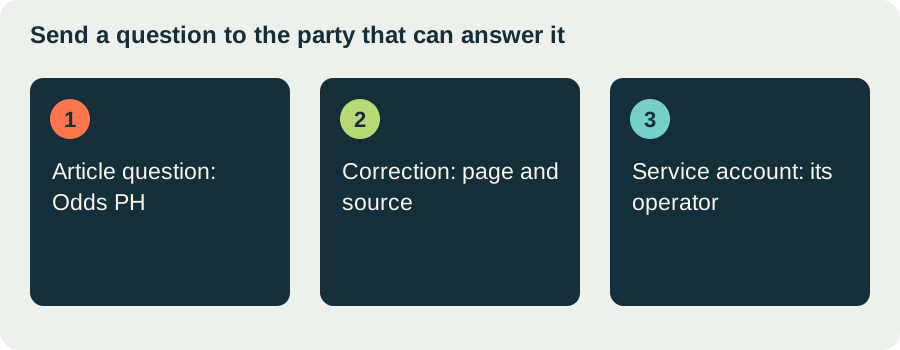
Odds PH is an independent information website. This email is not a support desk for a league, athlete, broadcaster, payment wallet or betting operator. We cannot open or manage an account with another service, change a transaction or confirm a subscription on its behalf. Use the relevant provider’s verified support channel for those requests.
Editorial address
English
11 Ortigas Avenue, Ortigas Center, Pasig City, 1605 Metro Manila, Philippines.
Filipino
11 Ortigas Avenue, Ortigas Center, Lungsod ng Pasig, 1605 Kalakhang Maynila, Pilipinas.
Choose the kind of enquiry you want to send
| Your enquiry | What helps us understand it | Where the answer belongs |
|---|---|---|
| Possible factual error | Page, exact statement and supporting record | Editorial review under the corrections policy |
| Unclear explanation | The step or term that caused confusion | The article or guide concerned |
| Broken source link | Odds PH page and the link’s visible name | The reference attached to that article |
| Missing topic | The question you wanted the guide to answer | A possible future editorial decision |
| Rights concern | The material, page and your connection to it | A specific review of that material |
| Publication or commercial enquiry | A clear proposal and the organisation represented | A separate discussion from factual reporting |
You do not need to know an internal department name or find a particular staff member. A descriptive subject and a short statement of the issue are enough to begin. Sending the same request under several unrelated subject lines can make the surrounding context harder to follow.
A useful structure for an editorial email
Put the main request in the first sentence. Then identify the relevant article, explain the specific difficulty and supply a source or example if it helps. If there are several unrelated issues, number them. This lets a reader distinguish one disputed statistic from a broader suggestion about the article’s explanation.
A concise message can still be complete. “The total in the third row appears to add to 108 rather than 109; the four quarter values are…” is more actionable than “the basketball page is wrong”. It identifies the location, the type of problem and the calculation to inspect without demanding a particular conclusion.
Include the full page address rather than only the title, because similar titles can appear in navigation and related reading. If you found the statement through search or a shared screenshot, open the article and check that the wording still appears. An older image can describe a version that has already changed.
Example: asking about an unclear sports explanation
The following is an example of an enquiry, not a report of an actual error or a message from a real reader:
Subject: Question about the tennis tiebreak example
Hello Odds PH, I am reading [page address]. In the section [heading], I understand the game score but not which player serves the next tiebreak point. Could you clarify that step? I am asking about the example in the guide, rather than a live match. Thank you.
The useful details are the article, section and point of confusion. You do not need to send a full match recording to ask about an explanation. If your question is about an actual tournament using an unusual format, add its name and year so the competition’s rules can be distinguished from the standard example.
Example: suggesting a factual correction
For a factual issue, quote only the short statement you want checked and link the original record. The corrections policy explains how evidence and material changes are considered. This sample shows the information an email can contain:
Subject: Possible correction — [article title]
Page: [Odds PH page address]. Statement: [short quotation]. My concern: [what appears inaccurate]. Supporting record: [official results or announcement link], dated [date]. The relevant part is [round, table or paragraph]. I believe this may affect [the total, category or explanation], but please check the record.
Keep what you know separate from what you suspect. If you are unsure whether the two sources refer to the same match, say so. An uncertainty stated clearly is more useful than a confident allegation built on different dates or competition categories.
Example: reporting a broken reference
A source page may move, stop loading or begin showing a different record. Tell us which link you used from which article. A link opening but showing the wrong event is a different problem from a link returning an error.
Subject: Broken source link — [article title]
I opened [Odds PH page] and selected the source labelled [visible link text]. It led to [brief description of the result]. I tried it on [date]. If useful, the organisation appears to have a replacement page at [public source address].
You do not need to include your browsing history, account details or the contents of other tabs. A replacement source is helpful if you have already found it, but it is not a condition for reporting the problem. Please distinguish a publicly available reference from a page that requires your own paid login.
Example: suggesting a missing question
A useful topic suggestion starts with what you were trying to understand. It does not need to propose a title or dictate how an article must be written. Describe the decision or question that remained after reading the existing guide.
Subject: Guide suggestion — reading volleyball substitutions
I read [page address] while following [competition]. The scoring explanation helped, but I still wanted to understand [specific question]. An example showing [scenario] would be useful. I have included [public source] if it explains the competition’s particular format.
A suggestion does not create a promise that a new page will be published. Some questions fit an existing article, while others require evidence or a different type of coverage. We do not need readers to supply artificial examples of personal experience; an honest description of the missing answer is enough.
Publication, interview and commercial enquiries
For a publication enquiry, identify who you represent, the subject and the proposed use. If you are offering information, explain whether it is already public and where the underlying record can be found. Do not label promotional material as an independent sporting result.
For a commercial proposal, state the organisation and the service being discussed, plus the relevant public information. A proposed placement is separate from a correction request. Payment or a prospective business relationship does not establish the truth of a sporting claim. The funding and affiliate disclosure explains how advertising is distinguished from editorial material.
Do not send passwords, account access or private dashboards as part of an initial proposal. A public description and a clear point of contact are more appropriate. We do not need access to another person’s private information to understand what a service offers.
Rights and image concerns
If your concern involves an image, passage or other material, identify the exact page and the item on it. Explain your connection to the material and the action you are asking us to consider. A general statement such as “your images are mine” leaves the relevant item unclear.
You can describe an illustration by its position and visible subject, or provide the public image address if available. If a comparison is necessary, use a public reference or a limited relevant extract. Avoid sending a collection of unrelated personal photographs or identity documents to establish a simple initial enquiry. Further clarification can be discussed if needed; sending sensitive material pre-emptively is not required.
A concern about how an athlete is described belongs with the particular statement, not an assumption that the athlete operates this website. Odds PH does not act as an athlete’s agent or forward fan messages on an athlete’s behalf.
What not to include in an email
Do not send passwords, PINs, one-time codes, full payment-card numbers, account-recovery answers or copies of identity documents. They are unnecessary for checking an article. A screenshot should show the relevant statement or error, not expose unrelated account balances, contacts or private messages.
Before attaching an image, review the whole frame, including notification bars and side panels. Crop or cover details that are not needed to explain the issue. If a public link already shows the relevant information, that may be enough. The aim is to send the evidence needed for the question rather than the largest possible amount of data.
Do not post private information in a public place simply to make it easier to share with us. If the only evidence you have contains sensitive details, describe the nature of the evidence first. The privacy notice explains the website’s information-handling scope; this contact guide is about composing a suitable enquiry.
When the request belongs with another service
For a subscription charge, cancelled broadcast, wallet transaction or gaming-account problem, contact the service that holds the account or processed the transaction. Odds PH cannot see that provider’s records or change its decision. A link to a service or an advertisement does not give us access to its customer systems.
Similarly, a question about tickets already purchased belongs with the ticket seller or organiser. A venue’s schedule, admission arrangements and refund rules are not controlled by this publication. If our article has an incorrect source link, report that link as an editorial problem.
Following up without losing the context
There is no fixed response-time promise. Keep a copy of your original message and, if you follow up, use the same subject and identify what is new. A later official correction, a replacement record or a clearer explanation can change the evidence available for a request.
Do not resend sensitive attachments simply because a reply has not arrived. A duplicate message is not proof that an editorial conclusion has been reached or that a third-party service has been contacted. If you are asking several different organisations for help, make sure each message goes to the organisation responsible for that issue.
Describe what is visible before sending an attachment
An email can often describe an issue without attaching a file. For example: “On the court guide, the metric value in the third table row appears different from the paragraph below it.” That identifies the disagreement and location. If a screenshot would clarify the position of a figure, show the heading and relevant rows rather than an entire desktop with unrelated windows.
A useful redaction preserves the evidence while removing what the enquiry does not need. Keep the public article text, the visible error and the date where relevant. Cover unrelated email addresses, private notifications, account identifiers and personal messages. Do not replace the disputed number with a redaction; describe the number in the email if it cannot safely appear in the image.
Keep names and time references understandable
Use the spelling displayed in the record you are discussing and mention a familiar shortened name if it helps identify the person. For a time question, state whether your example uses the tournament’s local time or Philippine time. “The match says Tuesday” is incomplete if the two calendars are showing different time zones.
If the supporting source is in another language, identify the relevant passage and what you believe it means. You do not need to translate an entire long document to ask a focused question. Keep your interpretation distinct from the original wording so a reader can locate both.
Several concerns in one message
If two concerns belong to the same article, list them separately and give a source for each. A correct source for the final score may not answer a second question about the venue. If the concerns are unrelated, make the subject clear enough that a follow-up can identify which question it addresses. This helps preserve the context without adding private information or sending repeated copies of the same attachment.
Before you send
- Confirm that your question concerns Odds PH material or a suitable publication enquiry.
- Add the exact page and section when available.
- Put the requested clarification or correction in plain language.
- Link a relevant public source rather than a search-result headline alone.
- Remove passwords, payment details and unrelated personal information.
- Check that your subject describes the enquiry you are actually making.
For background on the publication, read About Odds PH. For evidence standards on a disputed statement, use the corrections policy. The contact address remains [email protected]; no additional account, paid service or private identity document is needed to send an editorial question.