
Report the statement that needs checking
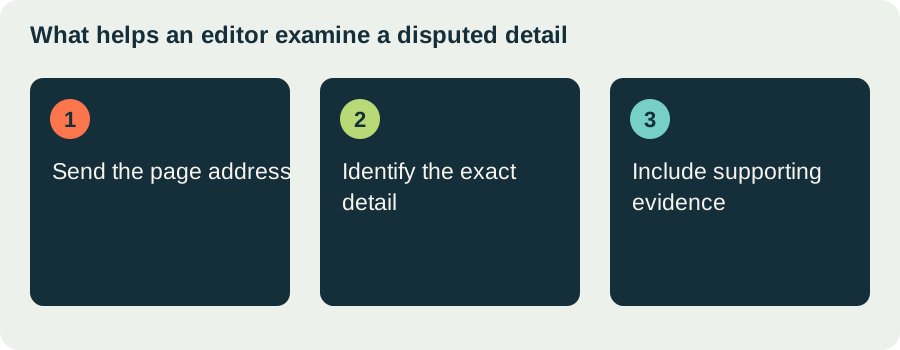
If an Odds PH article appears to contain a factual error, email [email protected] with the page address, the exact statement and a supporting record where possible. Identify the issue in plain language: a wrong result, an incorrect calculation, a mistaken category, a broken reference or an explanation that changes the meaning of a rule.
This policy explains how to distinguish those problems and how a meaningful correction should be described. For broader publication enquiries or help composing a message, use the contact guide. There is no fixed response-time promise. A report is a request to inspect the evidence, not a guarantee that its proposed replacement will be accepted unchanged.
What counts as a factual correction?
A factual correction changes a statement about what happened, who was involved, how a rule works or how a calculation was made. Replacing the wrong winning team, correcting a transposed score or repairing a formula that produces the wrong result affects the reader’s understanding. Those changes are different from making a sentence shorter or adjusting an unrelated image caption.
An interpretation can also contain a factual problem. A report might correctly state the final score but then say the winning team won every quarter when it did not. The score and interpretation should be checked separately. Similarly, a sentence about a title may use the right athlete’s name but the wrong competition level. A small wording change can therefore be a material correction.
Make sure two records describe the same thing
Before comparing sources, identify the competition, year, round and category. A women’s singles final is not the same record as a doubles final; a qualifying result is not a main-draw result. A tournament’s local date may also differ from the Philippine date on which viewers watched it. Those differences can make two accurate records appear contradictory.
For an athlete’s history, preserve whether the result was junior, professional, national-team, club, Olympic or world-championship competition. For a team record, preserve the season and stage. The goal is not to find a number that looks similar to the disputed number, but to establish whether it answers the same factual question.
A useful correction report can say that this identification is uncertain. “These may be two different events; can you check which is meant?” is a legitimate question. It is better than presenting one event’s result as conclusive evidence against a statement about another.
Evidence that makes a report stronger
An original results sheet, rulebook, official announcement or relevant provider notice is usually more informative than a search-result summary. Link the record and identify the part that matters. A long document without a page, section or table leaves the central evidence harder to locate.
The official sports resource directory explains which records answer different questions. A match centre can establish a completed result; an order of play can establish a scheduled day and court; a rulebook can establish a scoring condition. A current profile can establish biography or a listed title, but may not settle the precise score of every historical match.
Evidence should be weighed for relevance as well as origin. An official page can be outdated, and a newer summary can contain a transcription error. A later correction notice may explain a changed figure. Where two primary records conflict, the review should preserve the disagreement rather than silently choosing the number that creates the easiest story.
A changing fact is different from an earlier error
A league can reschedule a match after an article accurately described the original appointment. Updating the date is then a response to new information, not necessarily a correction of an earlier mistake. The distinction matters because it tells readers whether the original statement was unsupported or the underlying sporting arrangement changed.
Consider a fictional fixture announced for Friday and officially moved to Saturday on Thursday. If the article correctly described Friday before that notice, the later change should be explained as a rescheduling update. If the article mistakenly wrote Saturday before any such notice, that is a separate transcription problem. The resulting date can look the same while the explanation of the change differs.
Use the same care with team rosters, broadcaster availability and rankings. Ask what was established at the time of the statement and what a later notice changed. Do not turn every difference between two dates into evidence that one publisher deliberately misled readers.
Worked example: an arithmetic error
Suppose an article’s fictional quarter scores are 24, 26, 28 and 22, but its final column says 101. Adding the four inputs gives 100. The relevant correction is to the sum or to an input, depending on what the example intended. The review should not replace the total merely because a reader prefers a more realistic-looking score.
For a real match, inspect the official period scores before changing the final. A mismatch might reflect omitted overtime, an incorrect quarter value or a transcription in the total. The arithmetic identifies an inconsistency; it does not establish which real-world input is wrong without the underlying record.
A transparent correction note can identify both the previous issue and the corrected calculation. It should also check neighbouring statements that used the wrong total. Repairing a table while leaving a paragraph that repeats its old result would not resolve the article’s inconsistency.
Worked example: a percentage with the wrong denominator
Imagine a guide showing eight successful attempts from 20 and labelling the result 50%. The correct percentage is 8 ÷ 20 × 100 = 40%. If the paragraph then compares that percentage with another player, the comparison also needs review. A denominator error can alter the meaning of more than one sentence.
It is useful to report the formula as well as the suspected answer. “Eight divided by 20 equals 40%, but the table says 50%” lets another reader reproduce the concern. Keep units attached: a percentage, percentage-point difference and decimal probability are different representations. A correction should not swap them without explaining the quantity being discussed.
Worked example: the right athlete, wrong achievement category
A junior Grand Slam singles title and a senior singles title are different records. A profile that leaves out the junior category can create a false impression even if its event and year are correct. The correction may be only one word, but it changes what the achievement means.
The same reasoning applies to an Olympic medal versus a world-championship medal, or a WTA 125 title versus a WTA Tour title. A material correction should retain the documented achievement while repairing the category. It should not erase the result altogether or inflate it into a different honour to avoid acknowledging the wording problem.
Worked example: a rule applied outside its scope
A standard scoring rule can be explained accurately yet applied to the wrong event. A statement about singles may not describe a doubles competition’s deciding format. A pickleball event may use side-out scoring while a comparison concerns an announced rally-scoring option. The review needs the format and rule edition, not merely a familiar phrase.
If the article’s example is explicitly hypothetical, check whether the assumptions were stated and followed. If it is meant to describe a real competition, compare those assumptions with the competition’s regulations. A correction can clarify the scope without repeating the entire rulebook or pretending that every organiser uses an identical format.
Rankings, fixtures and other dated records
A ranking belongs to a published list or a clearly labelled projection. When reporting a possible error, include the date and the ranking system. A position shown during an event can differ from the official list released later. A career-high ranking is another field again. Substituting one for another can make a comparison misleading.
A next-match listing likewise needs an appointment source, not just an entry announcement. If a player withdraws or an opponent changes after the draw, the article may require an update. Where the earlier statement was conditional, the review should preserve that wording rather than treating it as a promise that the match was guaranteed.
Spelling, names and quotations
A misspelled name should be checked against the relevant record, especially where shortened names, accents or different display orders are used. Two familiar spellings may identify the same athlete, while two similar names may identify different people. The aim is correct identification, not an automatic preference for whichever version appears in the most recent headline.
For a quotation concern, identify the short passage and the original public statement. Distinguish a direct quotation from a paraphrase or an article’s own analysis. If wording changes who appears to have said something, or changes the meaning of the statement, it is more than a cosmetic edit.
How a material correction should be visible
When a material factual statement is corrected, the affected page carries a dated note explaining the substantive change. A useful note says what was wrong and what has been corrected, with enough specificity for a reader to understand its effect. A vague “updated” label alone does not explain whether the score, category or interpretation changed.
Routine spelling or layout changes can be made without presenting them as newly discovered sporting facts. Meaningful additions, later official announcements and corrections should be described in a way that fits the change. The page’s update date does not, by itself, prove that every external record was checked again at that moment.
Disagreement about analysis
Readers can reasonably disagree about whether a performance was convincing, whether a tactical choice was effective or which sequence decided a match. A disagreement is not automatically a factual error. It can still reveal an unsupported assumption, an omitted result or wording that presents opinion as certainty.
Identify the factual premise you dispute. “I prefer a different interpretation of this comeback” is different from “the team was never behind, so calling it a comeback is inaccurate”. The second points to a claim that can be checked against the game sequence. The first may call for clearer explanation rather than replacement of the underlying record.
Unresolved reports and limited evidence
Some reports cannot be settled from the available public records. An inaccessible archive, conflicting official notation or an unidentified screenshot can leave an optional detail uncertain. The useful response is to explain the limit, remove a disputed non-essential detail where appropriate or keep a claim qualified until the evidence supports a more precise statement.
Lack of confirmation is not proof that the opposite claim is true. Nor does receiving a report establish misconduct by a player, official or service. A review should avoid repeating a serious allegation as fact merely because it appeared in an email.
Check the consequences of a corrected statement
A correction should follow the fact through the affected explanation. If a game total changes, a stated winning margin may change too. If a title category changes, a later comparison that called it a senior championship also needs attention. Checking only the first visible number can leave the article internally inconsistent even when the original report was valid.
Consider a fictional table showing Team A at 100 and Team B at 98, while a paragraph describes a three-point win. The immediate arithmetic gives a two-point margin. A review should identify whether the table or description reflects the intended inputs, then make the related statements agree. It should not simply change both teams’ scores to preserve the paragraph’s preferred margin.
For a reader reporting an issue, this does not mean you must inspect every paragraph before sending an email. Identify the fact you found and any obvious related statement. The wider consistency check is part of evaluating the change, not a condition that prevents someone from reporting one clear error.
Keep the enquiry relevant and safe to review
Send only the material needed to identify the concern. Do not include passwords, one-time codes, payment credentials or identity documents. If a screenshot contains unrelated personal information, remove it before sending. A public sporting record and a precise explanation usually provide a better starting point than a large collection of private account images.
For a follow-up, preserve the original page and statement and identify the new evidence. An official correction published later may change the assessment. A repeated message with no additional information does not establish that a different result is now supported. The aim of the process is a more accurate and understandable article for every reader.