
How volleyball scoring works
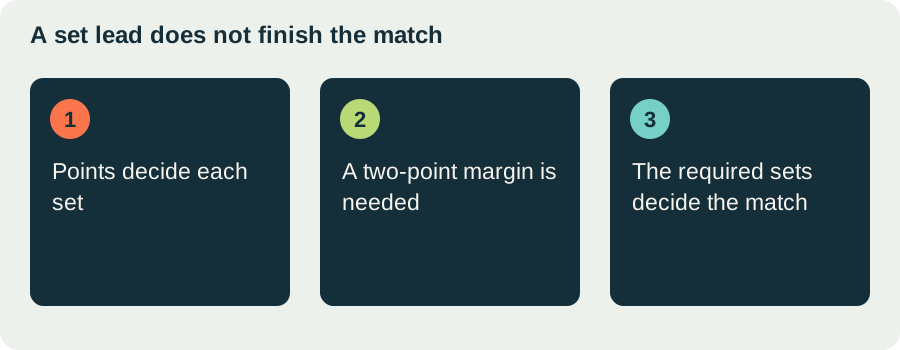
Standard indoor volleyball uses rally scoring: the team that wins a rally earns a point, whether it served or received. Teams collect points to win sets, then sets to win the match. The first team to win three sets wins a best-of-five match. The first four sets have a target of 25 points; a deciding fifth has a target of 15. In every case the winner needs a two-point lead. These are the scoring principles in the FIVB Official Volleyball Rules 2025-2028, rules 6.1-6.3.
The two levels explain a typical television scoreboard. A large 21-19 can be the current set’s rally score, while a smaller 2-1 shows sets already won. A team leading the current set is not necessarily leading the match. Read the team names, set count and current points together before interpreting the situation.
What changes after each rally?
If the serving team wins, it gains a point and serves again. If the receiving team wins, it gains a point and takes the next serve. When a team wins service back, its players rotate one place clockwise. The FIVB basic-rules guide explains that connection between service and rotation.
Consider a fictional first set at 8-8. Team A serves and loses the rally: Team B leads 9-8 and serves next. Team B then serves into the net: the score becomes 9-9 and service returns to Team A. The second error has given away both a point and the chance to keep serving. Neither team needed to be serving to earn its latest point.
Deuce: why 25 points may not be enough
At 24-24, neither team can win with only the next point. A 25-24 lead is set point, but play continues because the margin is only one. If the leader wins again, 26-24 ends the set. If the other side equalises, the score becomes 25-25 and the same problem begins again.
| Score in sets 1-4 | Has the set ended? | Reason |
|---|---|---|
| 25-23 | Yes | The target has been reached with a two-point margin. |
| 25-24 | No | The leader is only one point ahead. |
| 26-24 | Yes | The margin is now two. |
| 28-28 | No | The teams are level again. |
| 30-28 | Yes | The two-point lead has finally been created. |
A high final score is therefore not a separate scoring format. It can simply mean the teams kept answering each other’s set points. There is no general 30-point cap in this standard indoor format. Do not import a points cap from a recreational event or a different league without checking its rules.
The fifth set: a shorter target, the same margin
A 2-2 match goes to a deciding fifth set. Although its target is 15, a 15-14 lead does not end it. At 14-14, the next winning pair of consecutive points would produce 16-14; if the teams trade points, the set can continue further. Volleyball World’s match-format explanation distinguishes this shorter deciding set from the first four.
Imagine Team A leads the fifth 14-12. It has match point because one more rally would make it 15-12 and complete its third set win. If Team B wins the next two rallies, the score reaches 14-14. Team A’s earlier lead has not banked a victory; it must now create a two-point margin again.
A complete match, worked through
These are fictional scores chosen to show why sets and total points must be kept separate.
| Set | Team A | Team B | Set winner |
|---|---|---|---|
| 1 | 25 | 23 | A |
| 2 | 25 | 23 | A |
| 3 | 10 | 25 | B |
| 4 | 10 | 25 | B |
| 5 | 15 | 13 | A |
| Total rally points | 85 | 109 | Not the match-winning test |
Team A wins the match 3-2 even though Team B scores 24 more rally points overall. A wins three sets narrowly; B wins two by large margins. Extra points earned in a set that is already going well cannot be carried into the next set. This makes the set-by-set story more informative than a single combined points total.
A result may also be written from the losing team’s perspective. “A beat B 3-2” and “B lost to A 2-3” describe the same match. Check whose name is being used as the reference before comparing two result lists.
Set point, match point and a deciding set
- Set point: the team can win the current set by winning the next rally.
- Match point: winning the next rally would also complete the match.
- Deciding set: the set that settles a tied match; in a standard best-of-five this is set five.
At 24-20 with the match tied 1-1 in sets, Team A has set point but not match point. At the same rally score while leading 2-1, it has both. At 24-24 there is no set point for either team, because neither could finish the set with only one more point.
Not every awarded point is a spectacular attack
A team can gain a point because the opponent commits a fault. The scoreboard records the result of the rally, not the entertainment value of the final touch. A missed serve can therefore count just as much toward the set target as the end of a long exchange.
For individual statistics, do not assume the winning team’s every point belongs to one of its attackers. Separate player scoring contributions from points gained through the opponent’s errors. A team can also improve its chances by making a useful defensive touch that never appears in the top-scorer total.
Match scores are not league standings points
Winning three sets completes the match; the conference decides what that result contributes to the league table. A column called points in the PVL standings is not necessarily the sum of points hit over the net. Set ratio, point ratio and qualification rules are separate calculations.
Likewise, a best-of-three exhibition or a school event can use a different match structure. The examples here explain the standard indoor best-of-five system. Check the competition’s format before applying them to beach volleyball, a shortened tournament or a special event.
How many set points does a team have?
The phrase “three set points” can describe the cushion at the end of a set rather than three points awarded at once. At 24-21 in a normal set, the leading team can finish with its next rally win. If it loses that rally, it still leads 24-22; another loss leaves 24-23. A third lost rally produces 24-24 and removes the cushion. Every one of those rallies is still played and scored separately.
At 24-24 there is no stored advantage from having led earlier. If Team A wins, it leads 25-24 and has set point. If Team B wins the following rally, the score becomes 25-25. The important question is the current two-point margin, not which side reached 24 first. A saved set point is a situation survived, rather than a point subtracted from the opponent’s score.
Read a scoreboard from the named team’s perspective
A compact result can be easy to reverse when the winning team’s name moves between the first and second row. Read one team’s score consistently through the whole display. If Team A is shown second, a line reading 23-25 may describe a set A won, even though the smaller number appears first.
Try writing a fictional match as a sentence before interpreting its pattern: “Team A beat Team B by three sets to one.” Then record the set scores with A’s points first every time. That simple habit prevents an accidental switch halfway through a recap. It also helps distinguish a match tied at one set each from a score that is merely 1-1 in the opening rallies of a set.
| Reference team | Match score | Meaning |
|---|---|---|
| Winner A | 3-1 | A won three sets and lost one. |
| Loser B | 1-3 | B won one set and lost three. |
Why a service run can change the set quickly
Because the serving team keeps service when it wins the rally, one player can serve through a run of points. The points need not all be aces. A difficult serve can lead to a controlled return and a later attacking opportunity; an opponent’s fault can also finish the rally. A personal service run and a personal points total therefore describe different contributions.
Imagine Team A trails 16-19 and wins five consecutive rallies while the same player serves. The score becomes 21-19. The team has gained five points, while the margin has moved from minus three to plus two. It has not gained ten scoreboard points: the difference changed by five because B’s score stayed at 19. Keeping the two teams’ totals in view is clearer than describing every momentum change as a completely new match.
A lead can be valuable without being decisive
At 20-16 a side needs five more points to reach the normal target, provided it retains the required margin. Its opponent can still win the set. At 24-16 the leading side needs one rally, but each rally it loses leaves the score closer. Neither position is a completed result until the finishing conditions have actually been met.
The same distinction applies between sets. A 2-1 match lead is one set away from victory in best of five. The next set does not begin with a point bonus. Both sides start its rally score at zero. An earlier set won by ten points gives no extra credit in a later tight finish. That separation is part of what makes a comeback possible.
Do not confuse a scoring attack with the only useful touch
If you are taking notes, record the final point and one important earlier action separately. For instance, “A scores after a controlled block touch kept the rally alive” explains more than naming the hitter alone. It also prevents a common interpretation error: assuming a player with few attacking points must have contributed little. The full player-role discussion belongs in the PVL viewing guide.
Check a set-by-set result for simple consistency
A completed standard match needs one team with three set wins. There should be three, four or five completed sets, unless the official outcome involves a default or another special situation. For ordinary played sets, inspect the target and margin. A recorded 25-24 set would not satisfy the two-point rule; 26-24 would. A deciding-set entry of 15-14 raises the same question.
A suspected inconsistency is a reason to consult the official record, not permission to invent the missing point. A cropped image may have omitted a later rally, or the display may show an in-progress score. Do not turn an unfinished screen into a final result simply because the next fixture is already on television. The status label matters alongside the numbers.
A short practice exercise for new spectators
Take these fictional situations one at a time. At 24-23 in set two, Team A leads the match 1-0. A wins the next rally: the set finishes 25-23 and A leads 2-0 in sets. The match continues because A has not yet won three sets. Now imagine the identical rally score in set four with A leading 2-1. A wins again: that set and the match finish together.
Finally, consider a deciding fifth at 14-13. A wins the rally and finishes 15-13, taking the match 3-2. If B wins instead, the set reaches 14-14 and continues. These examples show why “one point from winning” is incomplete unless you say whether you mean the rally’s game situation, the current set or the entire match.
Indoor and other volleyball formats should stay separate
Do not assume a result from a different format is an error just because it does not resemble a PVL result. A shortened competition may announce a different number of sets or target. Beach volleyball has its own regulations. First identify the event, then use its stated scoring system rather than trying to force every score into the indoor best-of-five examples.
Likewise, a league’s new playoff structure does not automatically change the rally targets inside each match. The route through a conference and the scoring of one contest are different layers. Read the event announcement for changes to the championship race and the match regulations for changes to play on court. This distinction keeps an unfamiliar competition format from making a familiar scoreboard seem more complicated than it is.
Quick scoring questions
Can an indoor volleyball match finish 2-0?
A standard best-of-five match requires three set wins. A 2-0 score may be an unfinished match or an event using a different format, so its status and regulations matter.
Does winning the first two sets guarantee victory?
No. The opponent can win the next three. A 2-0 lead is a strong position, but it is not the same thing as a completed match.
How long will a fifth set last?
Its lower target does not create a fixed finishing time. Extended scores, long rallies and interruptions can all add time. Keep that uncertainty in mind when planning around the PVL match schedule.