
Philippine time is eight hours ahead of Coordinated Universal Time: PHT = UTC+8. Manila, Cebu and Davao use the same time zone. For international sport, the difficult part is usually the overseas clock: an NBA listing may use Eastern Time, while a tennis tournament may publish the local time at its venue.
Start with the event date and the time zone written beside the fixture. Convert that complete appointment, then keep any qualification such as “not before” or “after the preceding match”. Converting an estimated start does not turn it into a guaranteed start.
Philippine time, PHT and PhST
PHT and PhST are both used for Philippine time. PAGASA is the national timekeeper and publishes the Philippine Standard Time service. On international fixture pages, selecting Manila or Philippines is usually clearer than relying on an abbreviation.
Be especially careful with PST. A Philippine page may use those letters for Philippine Standard Time, while a North American page commonly means Pacific Standard Time. The two clocks are sixteen hours apart. Check the city or UTC offset rather than guessing from the letters.
Convert UTC to Philippine time
Add eight hours to UTC. If the answer reaches 24:00 or later, subtract 24 hours and move to the next calendar day. These are worked time conversions, not scheduled sporting events.
| Original appointment | Add eight hours | Philippine date and time |
|---|---|---|
| 10 June, 09:00 UTC | 09:00 + 08:00 | 10 June, 5:00 PM |
| 10 June, 15:30 UTC | 15:30 + 08:00 | 10 June, 11:30 PM |
| 10 June, 18:00 UTC | 18:00 + 08:00 = 26:00 | 11 June, 2:00 AM |
| 10 June, 23:45 UTC | 23:45 + 08:00 = 31:45 | 11 June, 7:45 AM |
A common mistake is to change the hour but leave the original date. That is particularly confusing when looking for an NBA score: the league can file the game under the US date while a Philippine fan watched it the following morning. Search the adjacent date before concluding that a game is missing.
Eastern Time to Philippine time: why the gap changes
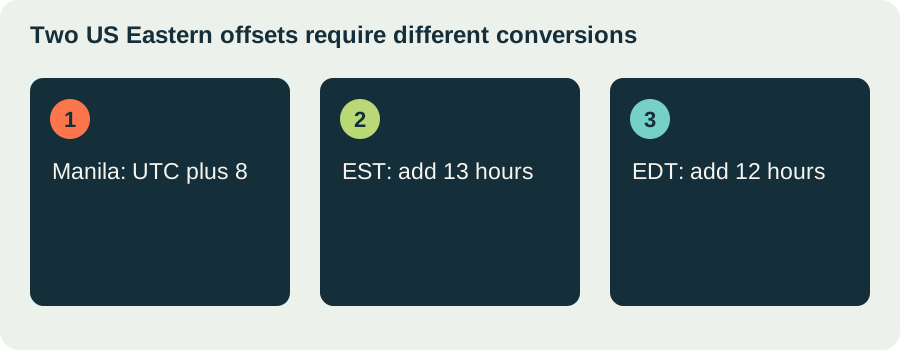
Eastern Time is an umbrella term. EST is UTC−5; EDT is UTC−4. Consequently, Manila is thirteen hours ahead of EST and twelve hours ahead of EDT. The Philippines does not make the corresponding seasonal clock change. NIST lists the US standard and daylight offsets.
For a fictional 7:00 PM New York appointment on 15 January 2026, add thirteen hours: 8:00 AM in Manila on 16 January. For 7:00 PM on 15 July 2026, add twelve: 7:00 AM on 16 July. The overseas city and local start are identical; the season changes the Philippine appointment.
| Host city | 15 January → Manila | 15 July → Manila |
|---|---|---|
| New York | 16 January, 8:00 AM | 16 July, 7:00 AM |
| Los Angeles | 16 January, 11:00 AM | 16 July, 10:00 AM |
| London | 16 January, 3:00 AM | 16 July, 2:00 AM |
| Paris | 16 January, 2:00 AM | 16 July, 1:00 AM |
| Dubai | 15 January, 11:00 PM | 15 July, 11:00 PM |
| Tokyo | 15 January, 6:00 PM | 15 July, 6:00 PM |
These two dates illustrate the difference; they are not a year-round conversion chart. Around a clock-change weekend, convert the actual appointment using its host city and date. Do not substitute “US time” for New York, Los Angeles or another named location.
Tennis match times: fixed, not before and followed by
A tennis order of play often combines several kinds of start. “11:00 AM” can identify the opening match on a court. “Not before 3:00 PM” sets an earliest start. “Followed by” means the match depends on the preceding contest finishing and the court becoming ready.
Suppose a fictional Paris match is listed “not before 3:00 PM” on 15 July. That converts to “not before 9:00 PM” in Manila on the same day. If the earlier match runs long, 9:00 PM remains the earliest appointment rather than a promise. Rain can also move the court or the day. Our tennis guide explains how draws and orders of play fit together.
Build a match reminder that survives a date change
- Write the competition, round and opponents. A league name alone is insufficient.
- Keep the host date, local time and host city in your note.
- Add the complete Philippine date and time, including AM or PM.
- Preserve “not before”, provisional or postponed labels.
- Check the event organiser again before travelling or setting an early alarm.
For a domestic PVL fixture, a Philippine venue normally removes the overseas conversion problem. You still need to distinguish the arena opening, first match and the later match you want to watch. A broadcast programme can also begin before actual play.
Work backwards from a Philippine appointment
Sometimes the question runs in the opposite direction. A friend has already saved a match at 8:00 AM in Manila and wants to know which overseas evening it belongs to. Start by subtracting eight hours to obtain UTC, then apply the host city’s offset for the date concerned. Do not simply reuse the host hour from a previous month.
For a fictional 8:00 AM Manila appointment on 16 January 2026, the UTC time is midnight at the start of 16 January. New York at UTC−5 is therefore 7:00 PM on 15 January. The earlier host date is essential: it is the evening before the Philippine appointment, not an evening after the game has already occurred.
Reverse conversion is also a useful check on a forward calculation. If converting the answer back does not recover the original date and local start, a sign, offset or date rollover has probably changed. Recheck those pieces before adding the event to a calendar.
Use the difference between offsets, with its sign
The conversion from a host clock to Manila is the Philippine offset minus the host offset. From UTC−5, that is +8 − (−5) = +13 hours. From UTC+9, it is +8 − (+9) = −1 hour. The minus sign means Manila is earlier than the Tokyo clock, not that an hour has disappeared from the event.
This explains why “add eight” works only when the starting point is UTC. Adding eight hours directly to a Japanese local appointment would count Japan’s offset as if it were zero. The correct operation for a 7:00 PM Tokyo appointment is subtracting one hour, giving 6:00 PM in Manila on the same date.
When a listing already says PHT or Manila, no additional conversion is necessary for a Philippine viewer. Read the label first. The most elaborate arithmetic cannot rescue an appointment whose starting clock has been identified incorrectly.
A viewing window can cross midnight without lasting a whole extra day
Consider a hypothetical viewing window from 11:00 PM on 19 December to 1:00 AM on 20 December in Manila. It lasts two hours. In UTC, the same window runs from 3:00 PM to 5:00 PM on 19 December. Two Philippine dates and one UTC date describe the same two-hour interval.
Subtract complete date-and-time values when planning the interval. Subtracting only the clock figures, 1 minus 23, produces a misleading negative number because it discards the date change. A short late-night event is not made longer by being written across two dates.
This is useful for sessions containing several fixtures. Record the advertised session opening separately from the match you want, and keep the expected finishing window flexible. A conversion can preserve an estimated duration, but an extended contest or interruption can still change the actual time you spend watching.
The UK and United States do not change clocks on the same weekend
Never assume the relationship between two overseas clocks stays fixed throughout a month. The UK government’s clock-change guidance lists 29 March and 25 October for 2026. The US rule described by NIST uses the second Sunday in March and the first Sunday in November, which fall on 8 March and 1 November that year.
During the gap between the March changes, New York has moved to daylight time while London has not. A fictional 7:00 PM New York appointment on 20 March 2026 is 11:00 PM in London that evening and 7:00 AM in Manila the next morning. On 10 April, the same New York local start is midnight in London and still 7:00 AM the next day in Manila.
The Manila appointment remains unchanged in those two examples because New York uses the same offset on both dates. The London appointment changes because its seasonal clock has moved. If a tournament publishes a time in a third country’s clock, convert the stated clock rather than substituting the venue’s usual relationship to Manila.
Do not let a numeric date choose the wrong month
A date written 03/04/2026 can be read as 3 April or 4 March, depending on the convention used. The ambiguity exists before any time-zone calculation begins. Write the month as a word when you save an international match: “3 April 2026” and “4 March 2026” cannot be confused in the same way.
For reminders shared with someone overseas, include both complete appointments and their city labels. “Tuesday morning” is a useful conversational shorthand only after everyone knows which Tuesday and which clock it represents.
Several start labels can belong to one sporting event
An arena opening time answers when spectators can enter. A broadcast start answers when coverage begins. The start of the first contest answers when play is scheduled to begin. An estimated main event or a later match answers another question again. All can be accurate without being identical.
Imagine a fictional event whose doors open at 4:00 PM, coverage begins at 5:00 PM and the first contest is scheduled for 5:30 PM. Saving only “5:00” may be enough to turn on the television, but it does not state when to travel or when play starts. Copy the label with the time rather than stripping the label away.
For a later tennis match, retain the dependency on earlier play. For a boxing main event, retain the estimate. For a league fixture, retain any postponed or provisional status. Time conversion translates the appointment; it cannot remove those sporting conditions.
Check a suspicious one-hour difference systematically
If two listings disagree by an hour, first compare their time-zone labels and their event dates. One might show Eastern Standard Time while the other uses current Eastern Time; one might show venue time while the other has already converted to Manila. Do not assume either has changed the fixture until those possibilities are separated.
Next check whether a calendar entry was created before a seasonal clock change. A manually typed fixed offset and a city-based appointment are not always equivalent across a season. Compare the actual event with the organiser’s latest date and clock, rather than trusting a saved reminder solely because it has been on your phone for weeks.
If the difference remains, use the organiser’s current notice to establish the appointment you should follow. A revised fixture should be treated as revised, not explained away with increasingly complicated arithmetic. The final aim is a correct match plan, not merely a conversion that adds up internally.
Put a mixed evening and morning programme in order
When a personal viewing list crosses midnight, sort complete Philippine appointments rather than clock times alone. A fictional game at 11:00 PM on Friday comes before one at 2:00 AM on Saturday, even though the second clock shows a smaller number.
Attach a date to each entry before adding travel, sleep or viewing plans around it. A label such as “Friday games” may refer to the organiser’s calendar rather than your overnight sequence. Preserving both dates explains why two fixtures belong together in the event’s listing but occupy different parts of your local weekend.
Questions about Philippine sports schedules
Is midnight the start or the end of a date?
12:00 AM is midnight at the start of the stated date. 12:00 PM is noon. A reminder saying Wednesday, 12:00 AM belongs to the night immediately after Tuesday evening.
Why does my phone show a different time from a poster?
The fixture page may already be converting to your device location, while the poster keeps venue time. Find the time-zone label first. Applying a second conversion to a time already shown in Manila creates another error.
Can the correct time still change?
Yes. A conversion answers what a stated appointment means in Manila. It cannot account for a later postponement, weather interruption or a revised order of play. The event organiser’s latest notice takes precedence.