
How tennis scoring works
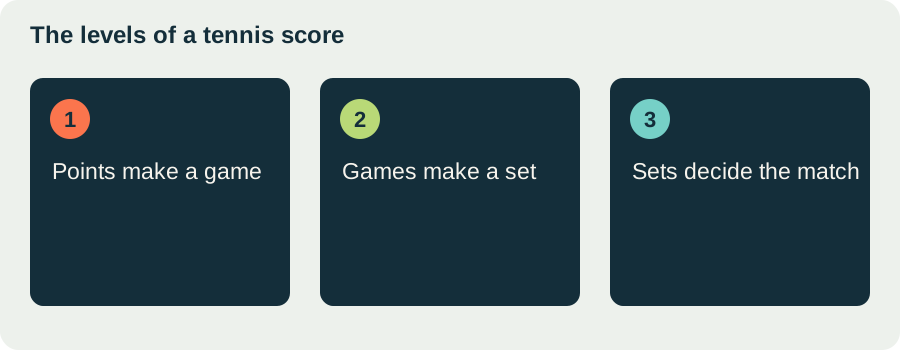
A tennis scoreboard carries three stories at once: points inside the current game, games inside the set and sets inside the match. Reading the rows in that order makes a tight match much easier to follow. The server’s point score is announced first, so 30–15 means the server has won two points in the game and the receiver one. It does not mean either player has won 30 rallies.
The usual sequence is love, 15, 30, 40 and game. At 40–40, or deuce, an advantage-scoring game requires two consecutive points: one to gain advantage and another to finish. If the player with advantage loses the next rally, the game returns to deuce. The USTA scoring guide explains these standard sequences and their tiebreak equivalents.
| Scoreboard detail | What it tells you | Useful question |
|---|---|---|
| Points: 30–40 | The receiver can win the game on the next point | Is this a break point? |
| Games: 5–4 | One player leads in the current set | Who serves next? |
| Sets: 1–1 | Each player has won one set | Is the next set the decider? |
| Small number beside 7–6 | A tiebreak detail | Does the display show one player’s points or the full tiebreak score? |
Sets, tiebreaks and match formats
In a standard tiebreak set, six games with a two-game lead wins the set; 6–5 is not enough. At 6–6, a tiebreak normally settles it. An ordinary seven-point tiebreak still needs a two-point margin. Thus 7–5 finishes it, while 7–6 does not. A set ending 7–6 can contain a much longer tiebreak than seven points.
Best of three sets means the first player to win two sets wins the match. Best of five means the first to three. Some doubles competitions use a match tiebreak instead of a full deciding set. In men’s and women’s singles, the deciding-set tiebreak at the four Grand Slams reaches ten points, with a two-point margin, when the set reaches 6–6. Always read the event’s format: a ten-point match tiebreak replacing a set is different from a ten-point tiebreak played after twelve games. The ITF tennis glossary distinguishes these scoring terms.
A worked example: why the serving player changes the picture
Consider a hypothetical best-of-three match in which Ana leads Bea 6–4, 5–4. Ana has one set and needs one more game, but the immediate situation depends on serve. If Ana serves at 5–4, winning her service game finishes the match. If Bea serves, Ana must break serve to finish immediately; otherwise the set becomes 5–5. Identical set and game totals can therefore describe different point-by-point situations.
Now suppose Bea serves at 30–40. Ana has a break point and, in this example, a match point too. Bea can erase it by winning the next rally. Calling the match over at 30–40 would miss the difference between an opportunity and a completed result. Watch the serve indicator, not just the larger numbers.
Read the tournament draw before following the schedule
A draw is the bracket. It shows a player’s opening opponent and possible route through later rounds. A seed is a protected placement based on the event’s seeding rules, not a guarantee of reaching that round. A qualifier has earned a place through qualifying; a wild card is an invitation into the draw. A bye allows a player to advance through a draw position without playing that round.
The draw does not assign a precise time to every future meeting. If two players could meet in the quarterfinal, each must first progress. An order of play tells you which matches are assigned to a day and court. Treat “followed by” as a sequence and “not before” as the earliest permitted start, rather than a promise that the first ball will be struck at that minute.
Following tennis from the Philippines
For a Philippine viewer, the date conversion is as important as the hour. A late match in the Americas can be the next morning in Manila. Tournament time and your phone’s automatically converted time may already be different; adding the offset twice is an easy mistake. Our Philippine sports time guide gives a step-by-step method for checking both date and time.
Use the WTA tournament calendar to identify the event, then open that tournament’s draw, scores and order of play. Keep a second check close to match time if earlier matches run long or weather interrupts play. A replay, highlights package and live broadcast are different products, so check the programme description before arranging your evening.
Rankings explain a season, not every individual match
A world ranking is a points-based record. It is not a prediction that the higher-ranked player wins every meeting. The WTA rankings explanation describes a rolling 52-week system in which tournament level and progress through the draw affect points. The calendar-year Race and an in-event live projection answer different questions from the published ranking list.
A hypothetical player can reach a semifinal yet fall in the rankings if a larger result from the previous year expires. Another can rise because rivals lose points. For a particular match, consider the surface, recent workload and the actual opponent alongside ranking; a single number cannot describe every tennis skill.
Serve and return: follow how the point begins
A serve starts a point, but the next ball often explains whether it created an advantage. An ace is a legal serve the receiver does not touch. A service winner can involve a return attempt that fails. A double fault loses the point after two unsuccessful serves. These categories describe different events, so a player can serve effectively without a large ace total. The WTA’s introduction to tennis explains the distinctions.
For a useful viewing exercise, choose one service game and note the returner’s position. Does a wide serve pull them outside the sideline? Does a body serve leave little room for a swing? After the return, is the server playing an attacking ball or recovering from pressure? You do not need to assign a numerical grade. The exercise connects the visible opening pattern to the next decision in the rally.
A second serve is another chance to put the ball in play, rather than another point. If the first serve misses and the second lands legally, the rally continues normally. The receiver does not receive a fraction of a point for the first fault. Similarly, a service let is not a successful point merely because the ball landed in the box. The umpire’s call determines the restart.
Read first-serve percentages with the missing denominator
A percentage needs a denominator. “First serves in” describes the proportion of service points on which the first serve landed legally. “First-serve points won” describes how often the player won after getting that first serve in. Those figures answer different questions. A high first-serve percentage does not automatically mean the serve produced easy points.
Consider a hypothetical player who contests 20 service points. Twelve first serves land in, and the player wins nine of those 12 points. The first-serve-in rate is 12 ÷ 20, or 60%; the first-serve-points-won rate is 9 ÷ 12, or 75%. Mixing the denominators would obscure what happened. If the player wins only three of the eight remaining service points, the second-serve-points-won rate is 37.5%, and the total is 12 service points won out of 20.
This example is a reading method, not a benchmark every player should meet. Opponent, surface and sample size matter. Compare a full tournament with another full tournament when asking about a trend; one pressured service game can look very different from the match average.
Break points are chances, not a count of different games
A break-point line can look dramatic because several opportunities may arise within the same game. Suppose a receiver has three break points in one long game, loses them all and eventually loses the game. That is not the same game pattern as creating one chance in each of three different service games. The summary ratio leaves that timing out.
Likewise, a hypothetical 2-for-4 break-point conversion means two opportunities were converted from four, not necessarily that the receiver broke in half of the opponent’s service games. To understand how often return pressure occurred, look at the service-game sequence as well. This is why a scoreboard, a statistics panel and the match narrative are useful together.
Winners, errors and the shape of a rally
A winner ends the point through a successful shot the opponent cannot return; an unforced error is an error judged to come without enough opponent pressure to explain it. Statistical judgement is involved in separating forced and unforced mistakes. The LTA tennis statistics glossary defines the common labels. Avoid treating one error count as an objective measure of every difficult decision a player faced.
Watch what happens before the final miss. A deep return can push an opponent behind the baseline; a short reply can then invite an attack. The last shot may be missed, but the point’s pressure began earlier. In another rally, a player may have time and space yet choose an unnecessarily narrow target. Both points end with a ball out, but a useful explanation distinguishes their development.
Surface and format change the viewing questions
Hard courts, clay and grass are different playing surfaces, not separate scoring systems. Rather than assuming one surface guarantees a particular winner, watch the bounce, the players’ positioning and the time available for the next shot. Ask whether a player is comfortable defending behind the baseline, coming forward or changing the height of the ball.
Match format changes the meaning of the same score. In a best-of-three match, a player leading two sets to none has won. In a best-of-five match, the opponent still has a route back. Doubles can add further variations in deciding-point or deciding-set arrangements. Check the competition format before importing a singles assumption into a doubles result.
What happens when the schedule is interrupted?
A rain delay or suspension can separate the original appointment from the resumed match. Keep the existing score attached to the same match and check the latest order of play for the resumption. A new day does not turn a partially completed contest into a new first-round fixture. An announcement of “play suspended” also does not establish which player won.
For Philippine viewers, make two notes: the tournament’s local day and the full Manila date you intend to watch. If a match resumes after midnight at the venue, compare the date as well as the clock. This is a scheduling interpretation, not a prediction of when earlier matches will finish. Use our time-conversion guide for the arithmetic and preserve the event’s wording about earliest starts.
A practical way to watch one complete set
- Before play: identify the format, surface, server and whether the score begins a new set or resumes an interrupted one.
- During service games: notice the first return and whether the server keeps an attacking position.
- At a break point: distinguish an opportunity from a completed break and watch how it is resolved.
- At the set’s end: record the set score, then add a short explanation of the decisive sequence.
- Afterward: compare that observation with the statistics, keeping the number of points and games in view.
A note such as “two return games reached deuce, one converted break, comfortable final hold” preserves more tennis information than “won easily”. It does not require access to advanced data or an invented performance rating. The aim is to connect a real sequence of points with an explanation you can check.
Common questions from new tennis fans
What does a break of serve mean?
It means the receiver wins the opponent’s service game. A break point is a chance to do so, not a break already secured. A player who wins a service game is said to hold serve.
Does a walkover count as a played match?
No. A walkover advances a player without a match being played. A retirement happens after play has started. Keep that distinction when comparing results and time spent on court.
Where should I start with Philippine tennis?
The Alex Eala profile follows the stages from junior titles to professional results and explains how to read her tournament activity. The broader Philippine athletes guide puts tennis achievements beside Olympic and world-championship performances in other sports.