
A score tells you who finished ahead. It does not automatically explain how the contest unfolded. A basketball team can win despite a lower field-goal percentage; a volleyball team can win fewer total points and still win the match; three boxing judges can disagree without any arithmetic mistake.
Choose a guide around the question you want answered. The explanations below connect the rules, the record and the numbers, with examples you can work through while watching a game.
Basketball: go beyond points scored
Start with how to read a basketball box score if abbreviations such as FGM, FGA, 3PM, REB and TO are getting in the way. A shooting line shows attempts as well as makes; rebounds can extend a possession or end the opponent’s chance. Minutes matter when comparing a starter with a reserve.
Then separate three questions. A game result describes one contest. A player’s box score describes contributions within it. Standings describe a team’s record across a competition. Combining these without checking dates and context can turn a strong individual total into the wrong conclusion about team performance.
- PBA basketball: conferences, competition context and the records to follow.
- NBA basketball: the season, standings, playoff path and the Philippine viewing day.
- NBA scores: game status, quarter totals and final results.
- Watching the NBA in the Philippines: broadcasts, subscriptions and access checks.
Volleyball: distinguish the rally, the set and the match
In indoor volleyball, a point advances a set and a won set advances the match. A 3–1 result means the winner took three sets; it says nothing by itself about the total number of rallies won. Three close won sets and two heavily lost sets can leave the match winner with fewer total points.
The volleyball scoring guide works through deuce, deciding sets and the difference between an attack point, block and service ace. The PVL guide adds Philippine competition context, while the PVL schedule guide helps you distinguish the match appointment from the start of a whole event session.
Boxing: read the decision, then the round totals
A unanimous decision means all three judges chose the same winner; it does not mean every round was clear. A split decision means the judges disagreed about the winner, rather than that each individual round had a particular margin.
Use how boxing scorecards work to see how round scores accumulate and why a knockdown or a point deduction changes the arithmetic. The broader boxing guide explains bout formats, result abbreviations and the difference between a scheduled card and an estimated ring-walk time.
Tennis and pickleball: similar equipment, different scoring
A tennis score such as 6–4, 3–6, 7–6 contains a match story: each pair describes a set, and the final set involved a tiebreak under the applicable format. A retirement or walkover needs a separate status; it should not be read as an ordinary completed score.
Our tennis guide connects points, games, sets and tournament draws. For the Philippine player’s background and dated achievements, see the Alex Eala profile. A player profile helps explain development and milestones; a current order of play answers the separate question of the next match appointment.
Pickleball has its own serve, bounce and non-volley-zone rules. Start with pickleball rules and scoring, then use the pickleball court dimensions guide to understand the kitchen, service boxes and the difference between the marked court and safe playing space around it.
Match times: save the Philippine date too
For international fixtures, the correct hour on the wrong date is still a missed match. A US evening game often falls on the next morning in Manila. An overseas clock change can move that Philippine appointment by an hour even if the host-city start stays unchanged.
The Philippine time guide contains worked conversions from UTC and common overseas locations, with explanations of midnight, Eastern Time and tennis “not before” appointments. Use the competition’s latest fixture information when plans depend on it.
Odds and probability: understand the arithmetic
Decimal odds, implied probability and a possible payout describe related numbers, not the same thing. At hypothetical odds of 2.50, a 100-unit successful selection returns 250 units including the stake; the net profit is 150, and the price implies 40% before considering market margin.
Read how odds work for formats, probability and overround. Use the odds calculator to change a worked example and see the outputs separately. Neither a price nor a calculation promises an outcome.
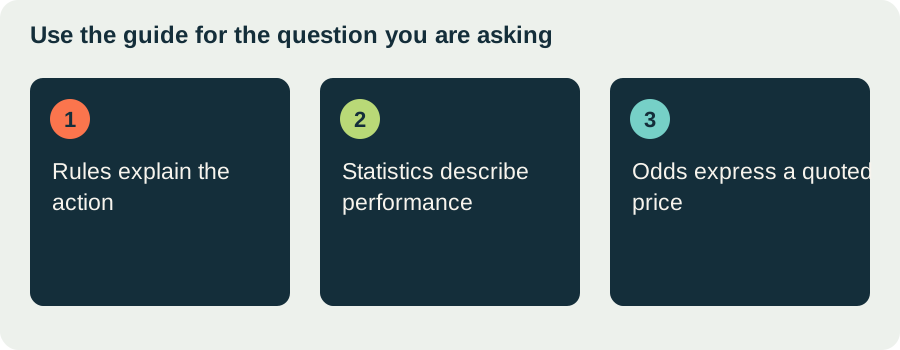
Choose the kind of answer before choosing the sport
Many sporting questions begin with the same words but need different material. “What does this result mean?” can ask who won, how the scoring system works or whether a team advances. Write the specific uncertainty in a sentence, then choose the explanation that addresses it.
| Your question | Best starting guide | What it helps you decide |
|---|---|---|
| What do the numbers beside a basketball player mean? | Basketball box scores | How recorded contributions and shooting attempts fit together. |
| Why did this volleyball team win with fewer total points? | Volleyball scoring | How rally points produce sets and sets produce a match result. |
| Why did the judges announce this boxing decision? | Boxing scorecards | How rounds and individual cards combine. |
| Which calendar day should I save in Manila? | Philippine time | How the original date and clock translate into a local appointment. |
| What space is needed for a pickleball court? | Pickleball court dimensions | The marked playing area and space around it. |
The table is a way into the subject, not a claim that all questions have one numerical answer. A rule can establish how a winner is determined while still leaving room to discuss why a side performed well. Start with the rule or record you need, then turn to interpretation.
If you have a screenshot and no context
Identify the sport and the kind of record before interpreting an isolated number. A 3–2 result can describe sets in volleyball, sets in another match format or a series in a different sport. The team names and the competition label help establish which reading is possible.
Then ask whether the image shows a completed result. A game in progress can be level or show a temporary lead. A bracket can contain a slot for an opponent that has not yet qualified. A saved graphic can remain visible after the organiser changes a fixture. None of those situations is resolved merely by reading the largest number correctly.
Use the sport’s main guide to identify the competition framework, the scoring guide for the number itself and the official record for its current status. This is a sequence of different questions, rather than three competing answers to the same question.
If you are returning after a season away
Begin with the competition’s current format and team context. A familiar cup name can survive a change in qualification or playoff arrangements. A player you remember can have moved into a different role or playing group. Older knowledge remains useful, but it should be attached to the period it describes.
The PBA guide is the place to understand separate conference championships. The NBA guide puts regular-season records, qualification and postseason progress together. The PVL guide explains why the series or conference label matters when you compare standings.
Once that framework is clear, choose one recent complete contest to follow closely. It gives the names, positions and competition rules a concrete setting. Trying to reconstruct an entire season from a highlights feed can leave the most important context out.
If you are deciding what a statistic can prove
Separate description from explanation. A points total describes recorded scoring. It does not automatically identify the most difficult defensive assignment, the best off-ball decision or why a team changed its rotation. Those can require footage and a relevant report as well as the numerical line.
For a hypothetical comparison, two basketball players may both score 15 while taking different numbers of shots and playing different minutes. The box-score guide helps identify those differences. A different question—whether one player should change teams or tactics—needs evidence beyond that single line and should not be smuggled into the arithmetic.
Use the same habit with boxing punch totals and volleyball scoring lists. Ask what the column counts, over which period and against which opposition. If the wording of the claim is broader than the measure, narrow the claim before hunting for more numbers.
If the next match is what matters
A career profile and an appointment answer separate needs. The profile helps place a player in a longer sporting story. The current order of play or fixture identifies the opponent, round, venue and day. Follow the Alex Eala profile for development and dated achievements, and the tournament’s current record for a particular playing appointment.
Our tennis guide helps explain how a draw connects potential opponents and why “not before” differs from a fixed opening start. For volleyball, the PVL schedule guide explains conditional fixtures, named pairings and event sessions.
Keep a potential opponent conditional. A position in a draw can identify who might meet the winner without establishing who actually progressed. That is a sporting dependency, not a time-zone mistake.
If you are trying a racket sport yourself
Read pickleball rules and scoring for how play unfolds. Use the court guide when the practical problem is where a player stands or how a marked area is arranged. Avoid transferring a tennis convention simply because both games use a net and a racket or paddle.
Likewise, a tennis result should be read through tennis points, games and sets, rather than assumed to use a simpler rally-point total. Choosing the right set of rules first saves a great deal of confusion about an otherwise accurate score.
Four short routes through a sporting question
“My team won the last quarter but lost the game.”
Start with the NBA score guide. Add the quarter totals and follow the running margin. The last period changes the full-game total; it does not replace it. If you then want to understand the shots and turnovers behind the change, move to the box-score guide.
“A 3–0 volleyball result looked close when I watched.”
Read the individual set scores in the scoring guide. Each set can end by a narrow margin even when one side wins all three. The match score accurately records set wins while leaving out how difficult each finish was.
“One boxing judge’s wider card should outweigh the others.”
Use the decision table in the scorecard guide. In the professional three-judge framework, first identify the winner or draw on each card. The overall decision is determined from those cards, rather than by combining every point into one large score.
“The advertised odds imply a certain win.”
Read how odds work for the distinction between a price and a probability estimate. The calculator can reproduce a payout calculation. It cannot establish the actual chance of a selection or remove the uncertainty of the sporting contest.
If access to the match is your immediate problem
Separate finding a result from obtaining video coverage. A live score can be useful when you cannot watch, while a replay can provide more detail later. Neither tells you automatically which subscription or television package carries a particular future event.
For NBA viewing, the League Pass guide connects the package, account, device and location questions. Use it when you are choosing or troubleshooting access. Return to the score guide when the problem is interpreting the game record. A subscription prompt and an unclear quarter total are different obstacles and need different explanations.
For other sports, begin with the organiser’s current viewing announcement and the rights holder’s event listing. A familiar logo in an old poster does not settle today’s coverage. Once the event is available, the relevant scoring or competition guide can make the viewing more understandable without being asked to act as the broadcaster.
A practical reading order
- New to the sport? Read its main guide for the format and vocabulary.
- Watching a match? Open the scoring or box-score explainer beside the official record.
- Planning ahead? Check the current fixture and convert its full date to Manila.
- Comparing performance? Keep the competition, opponent and sample size in view.
You do not need to master every statistic at once. Understanding why a number changes is usually more useful than memorising a long list of abbreviations.